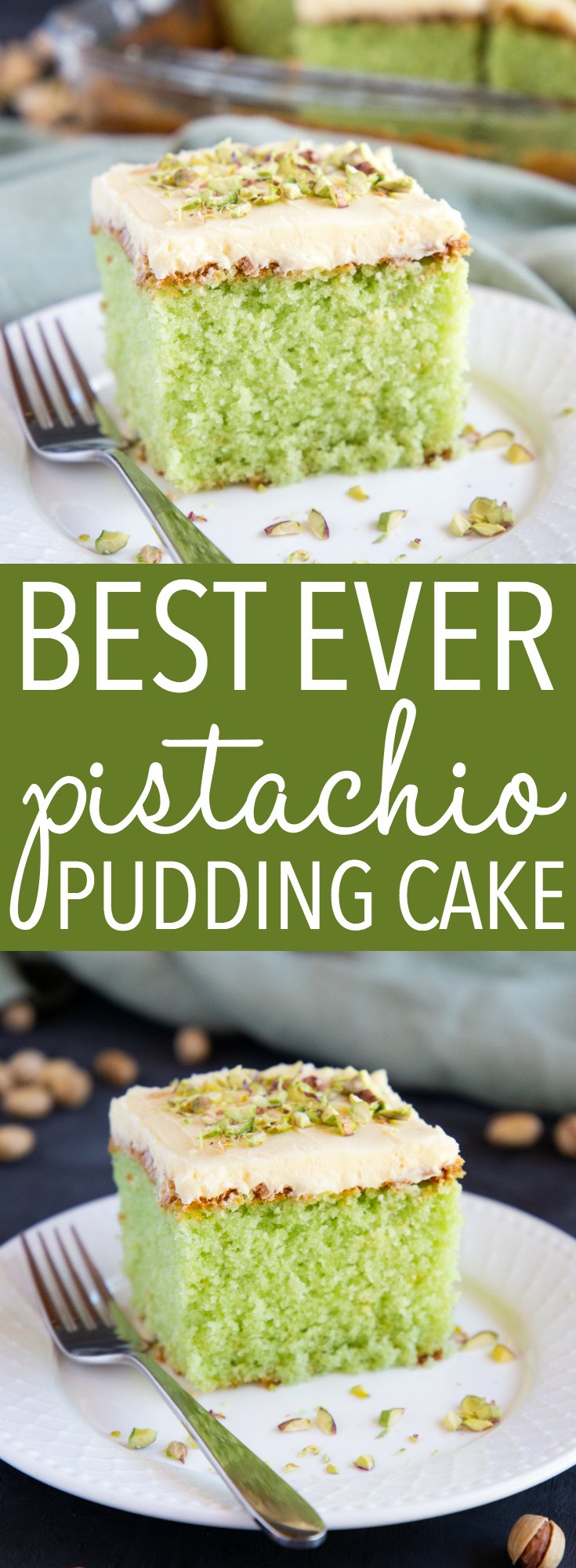
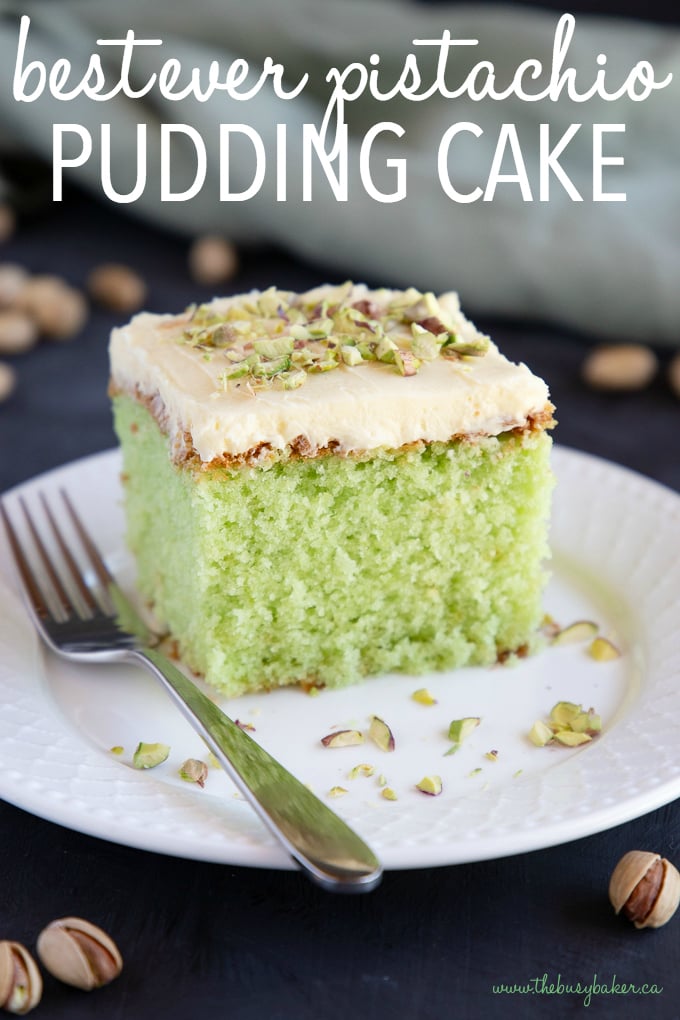
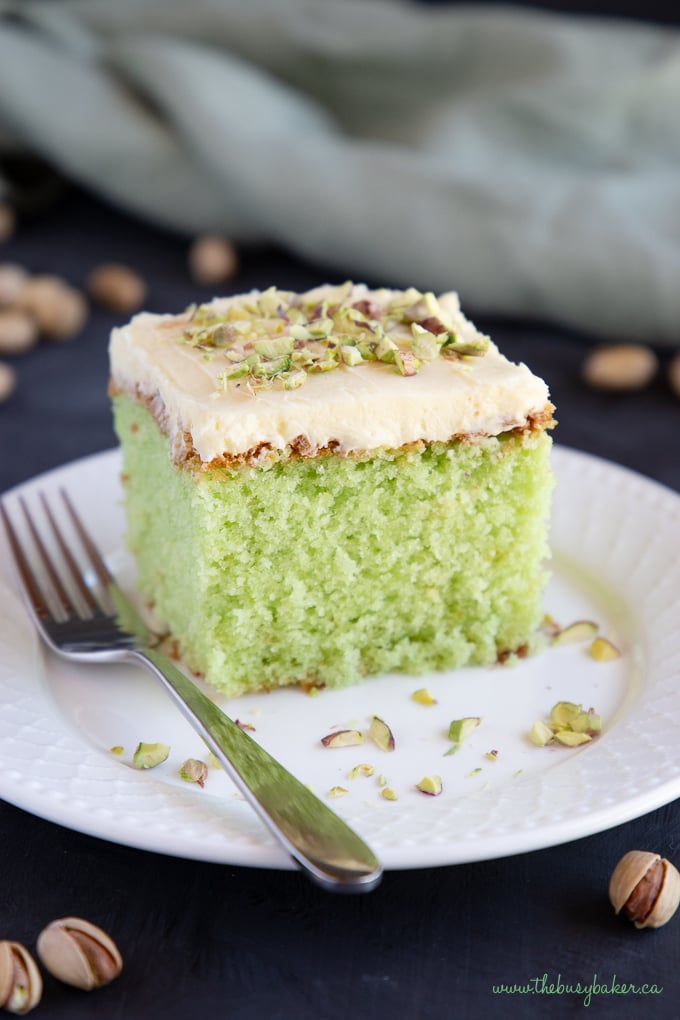
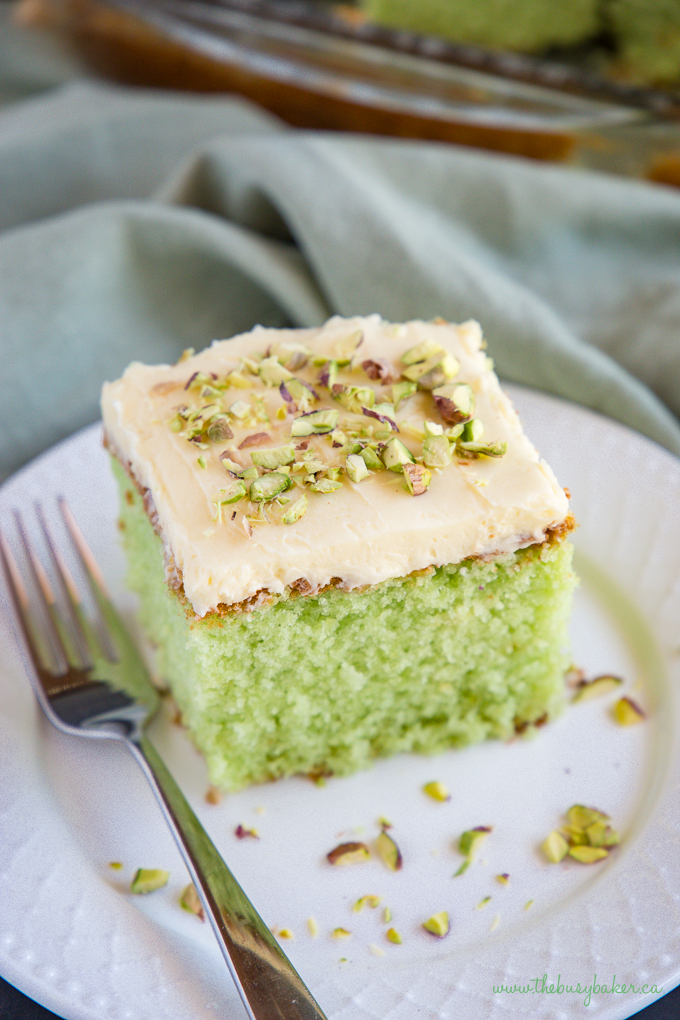
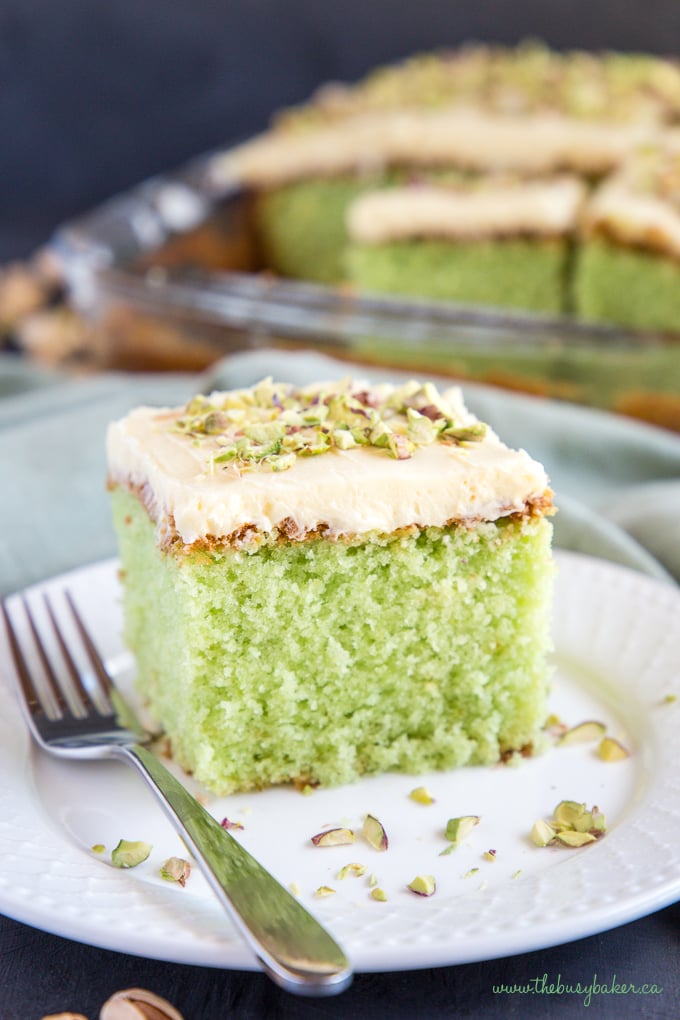
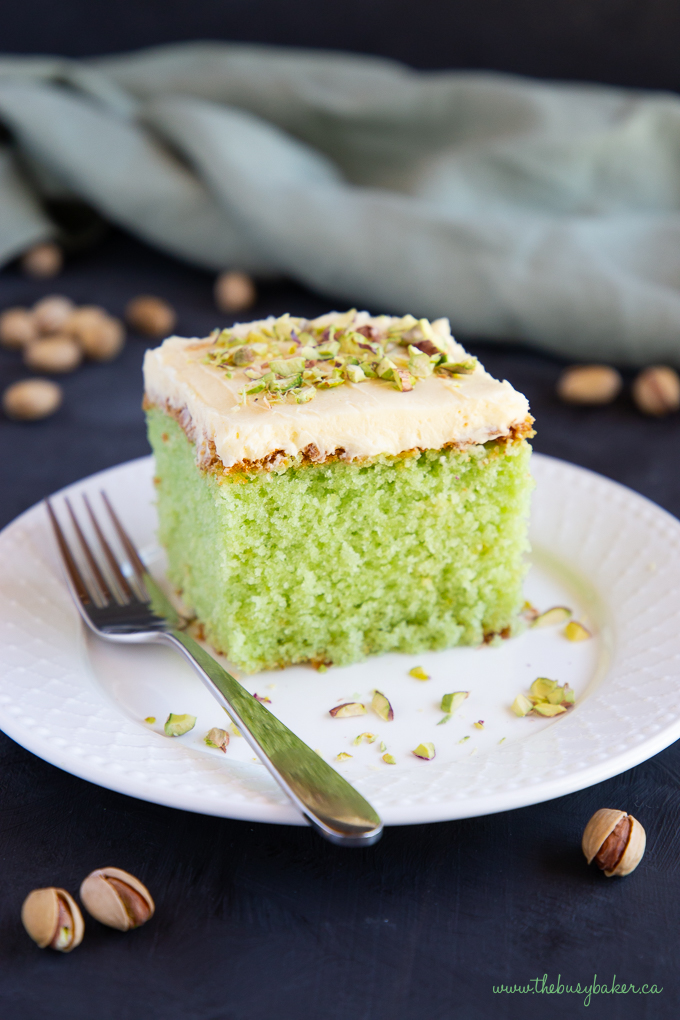
This Pistachio Cake recipe is so moist and flavourful with the perfect combination of pistachio and cream. It’s a tender pistachio pudding cake topped with a simple cream cheese frosting and crushed nuts!
Estimated reading time: 11 minutes
Pistachios are a delicious ingredient we love adding to desserts. They remind us of Italy, where sweet treats made with pistachios are abundant – whether it’s a cornetto or cannoli stuffed with pistachio cream, pistachio parfaits, or even pistachio gelato, we’re here for it. This Pistachio Cake is one of our favourite homemade desserts to make to satisfy our pistachio cravings. It’s easy to make, it’s SO moist and tender, and it goes great with a simple cream cheese frosting on top!
Here are just a few reasons we love this recipe for Pistachio Cake!
- It’s VERSATILE – This cake can be made in any type of pan – a 9x 13 baking pan like this recipe calls for, a bundt pan, or even 2 round cake pans to make it into a layer cake!
- It’s ultra-MOIST – Pudding mix makes this cake deliciously sweet and full of moisture.
- It’s EASY TO MAKE – This is a simple cake recipe to make and it’s perfect for beginning bakers!
Follow all our best cake baking tips for the BEST Pistachio Cake you’ve ever baked!
Make sure your milk and eggs are at room temperature. This will create a smooth cake batter and help the ingredients combine properly.
The best way to measure flour is in grams, but if you’re using cup measurements, be sure to fluff the flour in its bag or container before scooping VERY gently (don’t pack the flour into the measuring cup at all), then level it off with the back of a knife or other flat object.
Do not over-mix, especially after adding the flour. Over-mixing can create a dry, tough cake because it reduces the number of air bubbles present in the batter which give the cake its lift as it bakes.
This can create something called tunnelling where long, thin air bubbles appear in the baked cake. This is caused by vigorous mixing that strengthens the gluten strands in the cake batter too much. Instead, mix on low to medium speed just until the ingredients combine.
Always grease your cake pans generously with butter and dust the inside with cocoa powder or flour on all sides (use flour if you’re making a white cake and cocoa powder for a chocolate one). This will prevent the cake from sticking to the pan. We suggest using spring-form pans for baking round cakes for even easier removal.
Don’t let an unbaked cake sit out on the counter. Always preheat your oven first and bake the cake immediately after adding the batter to the pans. This will help the cake rise properly in the oven as the leavening agent in the cake batter is activated as soon as the wet and dry ingredients are combined.
Don’t place the pan too close to one side of the oven as this can cause it to brown unevenly. Add the pan to the centre of the oven so it bakes evenly.
Avoid opening the oven during baking unless it’s absolutely necessary to rotate the cake while baking (if your oven is small or has a hot spot). Opening the oven door at the end of the baking time is okay, especially because testing the cake with a toothpick is necessary to prevent over-baking.
Over-baked cakes are dry and crumbly. Be sure to remove them from the oven as soon as a toothpick inserted into the top of the cake comes out clean.
Under-baked cakes are partly baked but gummy on top and in the centre. Test the cake with a toothpick to be sure the cake is baked completely.
Don’t try to frost a cake that’s still warm, especially if you’re using a butter-based frosting as the butter will melt and you’ll be left with a mess. Wait for the cakes to cool completely, then frost.
If necessary, level the cake. Use a large serrated knife (like a bread knife) to cut any domed top off the cake before assembling and frosting.
Place the cake in the fridge once you’ve finished frosting it so the frosting can firm up. This will make the cake easier to slice and create clean, uniform slices.
If you are having trouble with this Pistachio Pudding Cake recipe, try the solutions we recommend below.
Measure ingredients accurately, especially leavening agents like baking powder or baking soda. If the batter is over-mixed it can result in excess air being incorporated into the batter, leading to uneven baking and sinking in the centre of the cake. Also, avoid opening the oven door during baking as this causes major changes to the oven temperature and will result in an uneven rise.
Measure the flour properly by spooning it into the measuring cup and levelling it off, rather than scooping it directly from the bag. Do not over-mix the batter as this can over-develop gluten in the batter and lead to a tougher texture. Mix until the ingredients are just combined and the flour disappears.
Make sure to measure the flour correctly, don’t over-mix, and check the baking time and temperature. Over-baking can cause the cake to dry out. Use a toothpick to check for doneness.
An oven temperature that’s too high can cause the cake to rise too quickly and crack on the surface. Double-check that the oven temperature is correct by using an oven thermometer. Avoid opening the oven door during the first half of baking as the sudden change of oven temperature will contribute to the cracking of the cake surface.
Make sure to properly grease the pan to keep your cake from sticking to the pan. You can line the pans with parchment paper to prevent the cake from getting stuck and it allows for easy removal from the pan. Let the cake cool for 10-20 minutes before inverting it onto the wire rack.
Check the freshness of your leavening agents, they lose their potency over time and can cause a cake to sink. Fresh ingredients are best. Also, make sure the oven is preheated to the correct temperature and avoid over-mixing the batter as it can deflate the air incorporated during the creaming process. Combine just until the flour disappears. The cake can sink in the middle if the cake is removed too soon from the oven. Let it bake until a toothpick comes out clean.
Make sure the cake has cooled before trying to spread frosting. A good idea is to refrigerate the cake first and make sure the frosting is soft enough to spread.
Refrigerate the cake after frosting or between frosting layers and frosting the outside. It will keep the cake firm. If the cake seems too soft to slice then refrigerate for 30 minutes to an hour before slicing.
To make this Pistachio Cake recipe, you’ll need these kitchen items on hand (paid links):
- Liquid Measuring Cup
- Stand Mixer or Hand Mixer
- measuring cups and spoons
- mixing bowls
- Silicone Spatula
- wooden spoon
- 9-inch x 13-inch rectangle baking pan
- Parchment Paper
To make this pistachio pudding cake recipe, you’ll need these ingredients (paid links):
FOR THE CAKE:
- 3/4 cup unsalted butter softened
- 1 1/2 cups white sugar
- 100 grams pistachio pudding powder approximately one 4-serving box (don’t use low fat or low sugar variety)
- 4 eggs
- green gel food colouring
- 1 1/4 cups milk
- 1/3 cup vegetable oil
- 1/2 teaspoon vanilla extract
- 1 3/4 cups all purpose flour
- 3 tablespoons cornstarch
- 4 teaspoons baking powder
- 1/2 teaspoon sea salt
- butter and flour for greasing the cake pan
FOR THE FROSTING:
- 8 ounces (220 grams) full fat cream cheese
- 1/2 cup unsalted butter, softened to room temperature
- 3-4 cups powdered sugar, sifted
- 1/4 teaspoon sea salt
- 3 tablespoons half and half
- chopped pistachios for garnish (optional)
Try these tasty variations on this Pistachio Pudding Cake recipe!
- Almond Pistachio – Add 1 teaspoon of almond extract to the batter to complement the pistachio flavour.
- Lemon Zest – Add lemon zest to the batter to enhance the subtle pistachio flavour and add a zesty citrus flavour.
- Coconut – Add shredded coconut to the batter for sweetness and added texture, then garnish with toasted coconut.
- Cherries – Add chopped maraschino cherries on top of the frosting for a fun red and green cake for those festive occasions.
Time needed: 1 hour and 20 minutes
Follow these steps to make the BEST Pistachio Pudding Cake recipe!
- Preheat the oven and prep the pan.
Preheat your oven to 350 degrees Fahrenheit (175 degrees Celsius). Prepare a 9-inch by 13-inch rectangular baking pan by greasing it with butter and coating the inside of the pan evenly with a thin dusting of flour. Set aside.
- Cream the butter and sugar.
In the bowl of your stand mixer fitted with the paddle attachment (or in a large mixing bowl with a hand mixer), cream the butter and sugar until light and fluffy (about 4 minutes).
- Add in the pudding mix.
Add the pudding powder and whip on high speed until incorporated.
- Add eggs one at at a time.
Add the eggs one at a time, mixing well after each addition. Add a tiny drop of green food colouring after the eggs, if desired.
- Combine the wet ingredients.
Combine the milk, vegetable oil, and vanilla extract in a separate bowl or pyrex measuring cup and whisk with a fork to combine.
- Pour the milk mixture into the butter mixture.
Add the milk mixture to the butter mixture slowly, mixing well until combined.
- Add in the dry ingredients.
Add the flour, cornstarch, baking powder, and salt, and mix on low speed just until the batter forms and no streaks of flour appear.
- Mix by hand.
Finish mixing by hand with a rubber spatula to be sure the batter is well combined (mixing with the electric mixer at this stage can cause over-mixing, so it’s best to finish it gently by hand).
- Bake the cake.
Pour the batter into the prepared pan and bake at 350 degrees Fahrenheit (175 degrees Celsius) for about 60 minutes (sometimes it requires 65 or even 70 minutes), or until a toothpick inserted into the middle of the cake comes out clean.
- Let it cool completely.
Let the cake cool completely in the pan before adding the frosting.
- Whip the cream cheese and butter.
In a large bowl with a hand mixer, whip together the cream cheese and butter until light and fluffy.
- Add in the powdered sugar.
Add the powdered sugar one cup at a time and whip on high speed until smooth.
- Add the half and half..
Add the half and half one spoonful at a time until a spreadable consistency is reached.
- Frost the cake.
Spread the frosting over the completely cooled cake and top with chopped pistachios, if desired.
- Serve.
Slice and serve.
Some recipes say to fold whipped egg whites or egg yolks into the batter to create lift but because this cake is not a sponge cake and the crumb is more dense, adding the eggs one at a time is best for this basic cake recipe. In this recipe, the whole eggs are beaten and incorporated into the batter after the fat and sugar have been creamed together. Beating the eggs helps incorporate air, contributing to a lighter cake texture. Add them one at a time to prevent curdling and ensure even mixing.
What kind of pudding is best to used for this Pistachio Cake recipe?
It is best to use instant pistachio pudding mix as it blends smoothly and helps create a moist texture.
Can I make a buttercream frosting instead of a cream cheese frosting?
Feel free to make the frosting that best suits your tastes and preferences. Just note that we can’t guarantee the taste as it differs from the recipe.
How do I store this Pistachio Cake?
Store the cake in an airtight container for up to 3 days in the refrigerator.
Can I make this cake into cupcakes?
Yes, the pistachio pudding cake can also be made into cupcakes. Make sure to adjust your baking time. Use a toothpick to check when they are done.
Can I use another style pan for the cake?
Yes, you can use a 9 x 13-inch pan, round cake pans, or a bundt pan. You will need to adjust the baking time. Start checking after 30 minutes or so.
What kind of food colouring works best, liquid green food colouring or green gel food colouring?
Gel food colouring is more vibrant that less drops are needed to achieve the colour. More liquid food colouring is needed to to get the desired colour.
We hope you enjoy this Pistachio Pudding Cake as much as we do! Let us know in the comments below, what’s your favourite pudding flavour? We’d love to know!
If you made this, share a photo!
Are you trying this recipe? Use the comment form below to share your take; now with support for image uploads and comment voting!
Pistachio Cake
Recipe: Equipment
Recipe: Ingredients
For the cake:
- 3/4 cup unsalted butter softened
- 1 1/2 cups white sugar
- 100 grams pistachio pudding powder approximately one 4-serving box, don’t use low fat or low sugar variety
- 4 eggs
- green gel food colouring
- 1 1/4 cups milk
- 1/3 cup vegetable oil
- 1/2 teaspoon vanilla extract
- 1 3/4 cups all purpose flour
- 3 tablespoons cornstarch
- 4 teaspoons baking powder
- 1/2 teaspoon sea salt
- butter and flour for greasing the cake pan
For the frosting:
- 8 ounces (220 grams) full fat cream cheese
- 1/2 cup unsalted butter softened to room temperature
- 3-4 cups powdered sugar sifted
- 1/4 teaspoon sea salt
- 3 tablespoons half and half
- chopped pistachios for garnish (optional)
Recipe: Instructions
- Preheat your oven to 350 degrees Fahrenheit (175 degrees Celsius). Prepare a 9-inch by 13-inch rectangular baking pan by greasing it with butter and coating the inside of the pan evenly with a thin dusting of flour. Set aside.
- In the bowl of your stand mixer fitted with the paddle attachment (or in a large bowl with a hand mixer), cream the butter and sugar until light and fluffy (about 4 minutes).
- Add the pudding powder and whip on high speed until incorporated.
- Add the eggs one at a time, mixing well after each addition. Add a tiny amount of green gel food colouring after the eggs, if desired.
- Combine the milk, vegetable oil, and vanilla extract in a separate bowl or pyrex measuring cup and whisk with a fork to combine.
- Add the milk mixture to the butter mixture slowly, mixing well until combined.
- Add the flour, cornstarch, baking powder, and salt, and mix on low speed just until the batter forms and no streaks of flour appear.
- Finish mixing by hand with a rubber spatula to be sure the batter is well combined (mixing with the electric mixer at this stage can cause over-mixing, so it’s best to finish it gently by hand).
- Pour the batter into the prepared pan and bake at 350 degrees Fahrenheit (175 degrees Celsius) for about 60 minutes (sometimes it requires 65 or even 70 minutes), or until a toothpick inserted into the middle of the cake comes out clean.
- Let the cake cool completely in the pan before adding the frosting.
- In a large bowl with a hand mixer, whip together the cream cheese and butter until light and fluffy.
- Add the powdered sugar one cup at a time and whip on high speed until smooth.
- Add the half and half one spoonful at a time until a spreadable consistency is reached.
- Spread the frosting over the completely cooled cake and top with chopped pistachios, if desired.
- Slice and serve.
Recipe: Nutrition
Notice: Nutrition is auto-calculated, using Spoonacular, for your convenience. Where relevant, we recommend using your own nutrition calculations.

TRY OUR MEAL PLAN BUNDLE!
Let us do the work for you with 11 WEEKS of deliciously easy family dinners, grocery lists, meal prep guides and so much MORE!
11 weeks of done-for-you family meal plans for only $9.99!
Correction to my earlier post. I altered the ganache recipe. No cream. I used Chocolate, butter, and simple syrup for the frosting. As I said in my earlier post, I’m lactose intolerant, so I have to be careful with milk products.
I made this for Father’s Day. Everyone loved it. I did make a change or two as I’m lactose intolerant. I used Greek yogurt 1:1 ratio instead of milk because I can have greek yogurt. I added 1/2 tsp of almond extract because I like it with pistachio. I kept the vanilla in the recipe. I read about people having issues with the cake falling, so I put the batter in the cake pan and then in a larger pan with water and then into the oven. Cake came out perfect. I also used a chocolate ganache instead of cream cheese because of the milk issues. Great recipe. This is a keeper.
Thanks so much for the comment Cynthia, so happy to hear you like the recipe!!