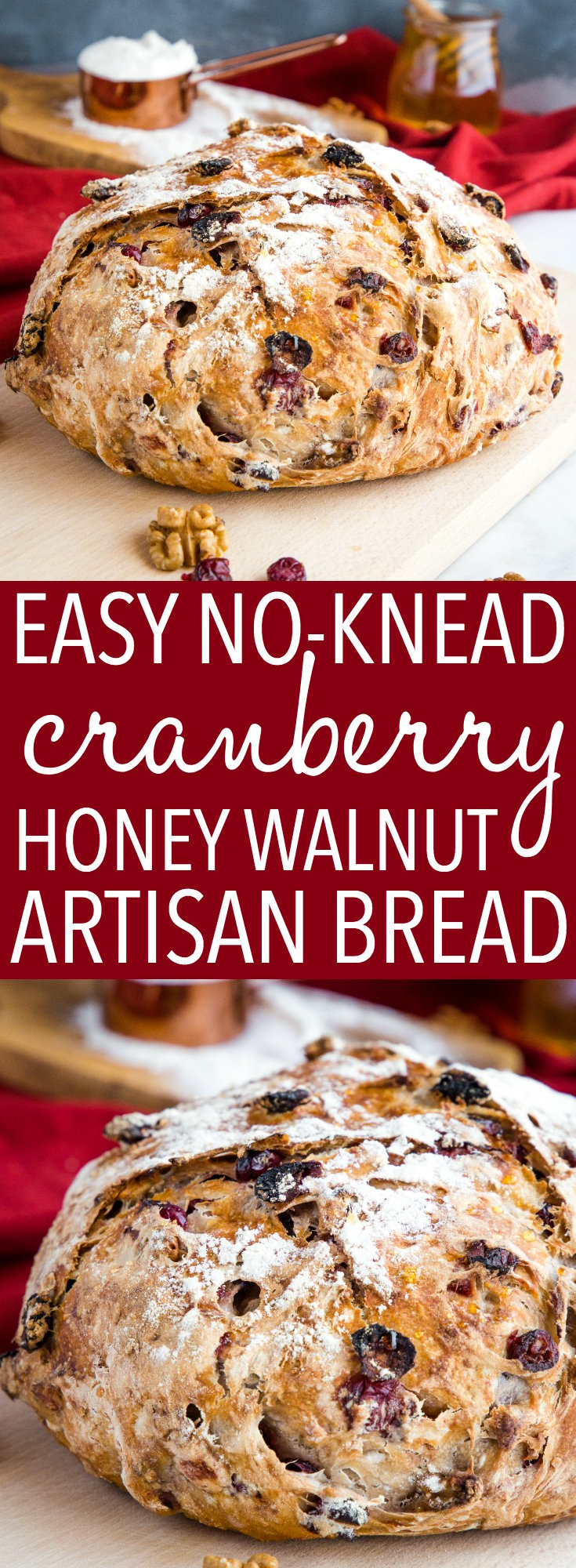
This No-Knead Cranberry Walnut Bread with Honey is a delicious bakery-style bread that’s sweet and delicious! Make it perfect with my easy pro tips for homemade bakery-style bread!
NEVER MISS A POST! FOLLOW ME ON:
FACEBOOK | PINTEREST | INSTAGRAM | TWITTER
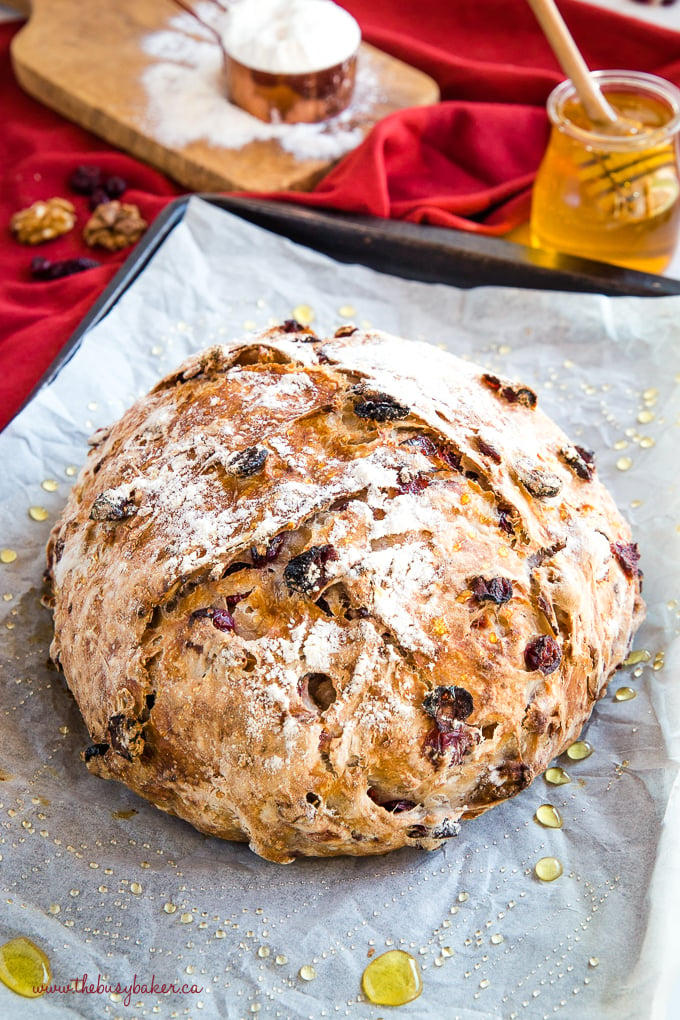
The BEST No-Knead Bread Recipe!
If you’ve been following thebusybaker.ca for awhile now you’ll already know how obsessed I am with no knead artisan-style bread recipes! Way back when I first started my blog I shared this Easy No Knead Artisan Bread recipe with you and it’s a recipe I’ve made more than a hundred times I’m sure, with countless flavour variations. My favourite variation yet is this No-Knead Cranberry Honey Walnut Artisan Bread! It’s delicious for breakfast or with a cup of tea in the afternoon, and it is a simply gorgeous loaf of bread that everyone will love, especially for the holidays! And with my pro tips, you’ll be able to make it too!
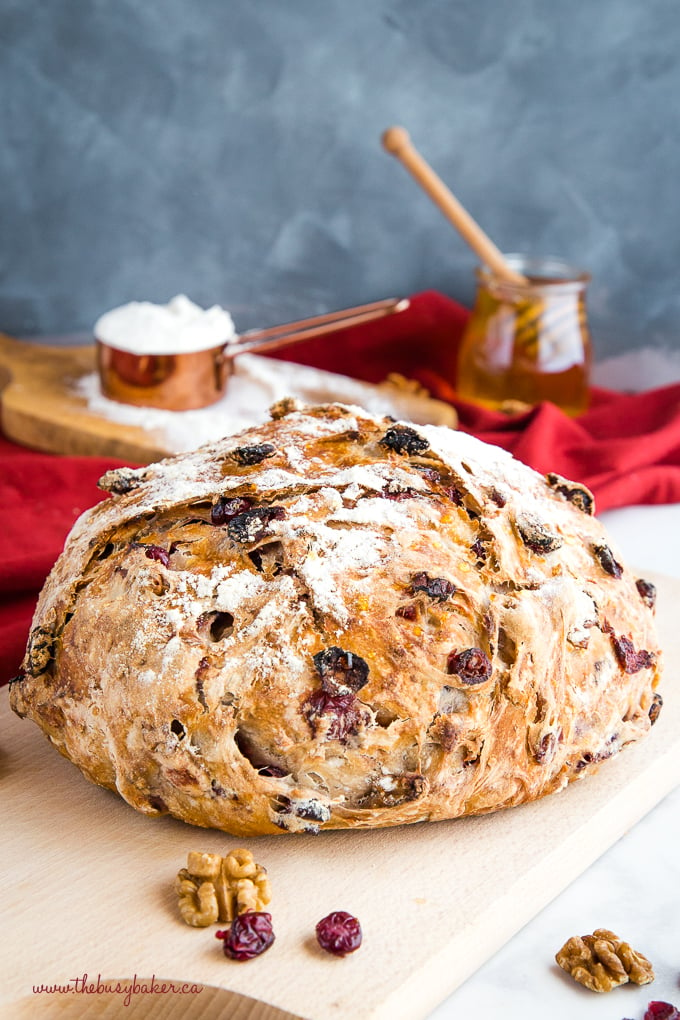
How to make Cranberry Walnut Bread
Pro tip#1: Pre-heat your Dutch Oven pot before baking.
This bread is baked in an oven-safe Dutch Oven pot which traps in steam, making the crust of the loaf extra crispy. Pre-heating the pot before baking helps make the crust even more crispy and golden brown! If you’re looking for a great Dutch Oven pot for making bread recipes like this No-Knead Cranberry Honey Walnut Artisan Bread, I will tell you that it’s one of the best investments you can ever make for your kitchen. Mine is a total beauty from Le Creuset (affiliate link) and I use it almost ever day throughout the year for soups, stews, sauces, curries, and of course for baking bread (if you want my original Dutch Oven Crusty Bread recipe, grab it HERE!). A pot like this one is definitely a financial investment, but considering how much I use mine and considering its high quality, it’s definitely a worthy investment since it will last for 10, 20 or even more years. I’ve also used similar cast iron pots from other brands, like THIS ONE from KitchenAid and THIS ONE from Lodge Cast Iron (both affiliate links) if you’re looking for something a little less expensive but still high quality that’ll do the job well.
EASY NO-FAIL HOMEMADE BREAD RECIPES AND BAKING TIPS
Get my easy no-fail bread baking e-cookbook!
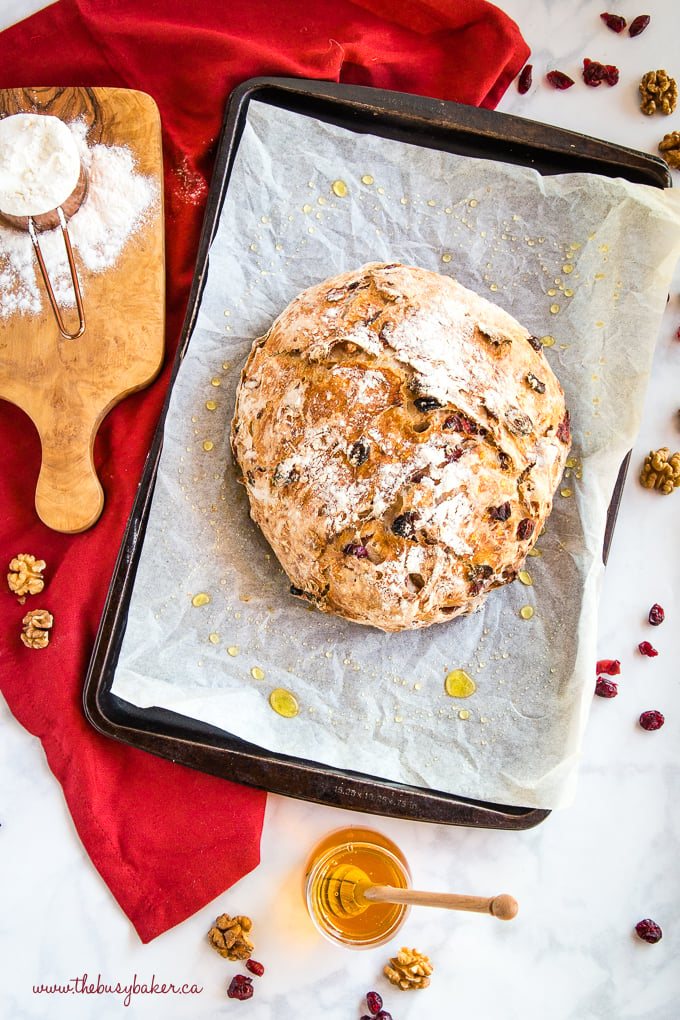
Pro Tip #2: Shape your loaf firmly but gently and dust the top of the loaf with flour.
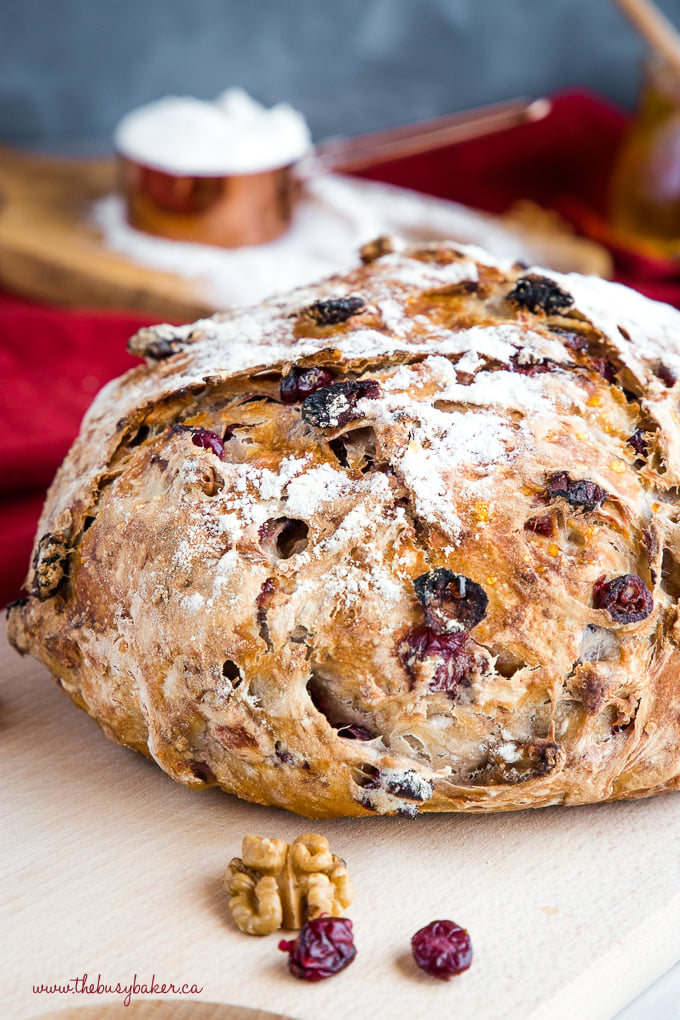
Creating a round shape will help the loaf bake evenly and dusting the top with flour will create that gorgeous, bakery-style appearance that everyone loves!
Pro Tip #3: Let the No-Knead Cranberry Honey Walnut Artisan Bread loaf cool completely before cutting into it!!
Resist the urge to slice the bread while it’s hot. Did you know that after removing a loaf of bread from the oven it continues to bake inside as it cools?? Slicing into this gorgeous loaf too early will cause the inside of the loaf to be under-cooked and gummy. Letting the loaf cool completely before slicing ensures the perfect fluffy texture when you slice into it!
NEVER MISS A POST! FOLLOW ME ON:
FACEBOOK | PINTEREST | INSTAGRAM | TWITTER
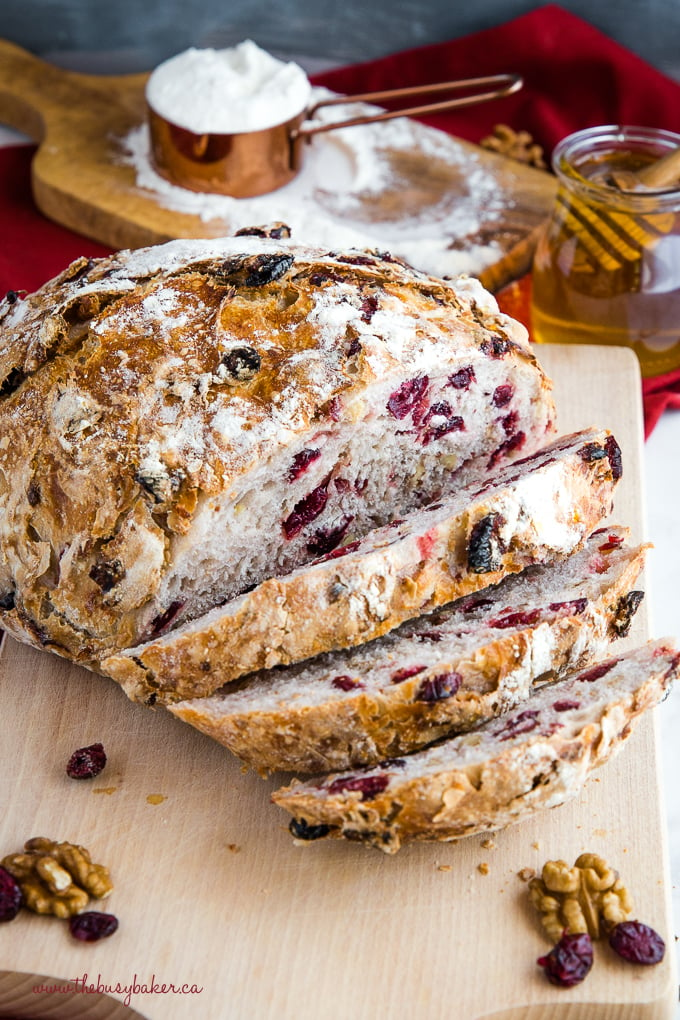
I hope you love this No-Knead Cranberry Walnut Bread with Honey as much as we do! Let me know in the comments below, what’s your favourite bakery-style bread to make at home? I’d love to know!
KITCHEN PRODUCTS I RECOMMEND:
Looking for even more delicious bread recipes? You’ll LOVE these:
-
Garlic Butter Dinner Rolls
-
Healthier Cornbread
-
Pumpkin Cornbread Muffins
-
Easy No Knead Artisan Bread
-
Easy No Knead Cinnamon Raisin Artisan Bread
EASY NO-FAIL HOLIDAY RECIPES AND COOKING & BAKING TIPS
Get my easy no-fail holiday meals e-cookbook!
RECIPE VIDEO
Watch the video below to see exactly how I make this delicious bread recipe. You can find more delicious recipe videos on my YouTube channel.
If you made this, share a photo!
Are you trying this recipe? Use the comment form below to share your take; now with support for image uploads and comment voting!
No-Knead Cranberry Walnut Bread with Honey
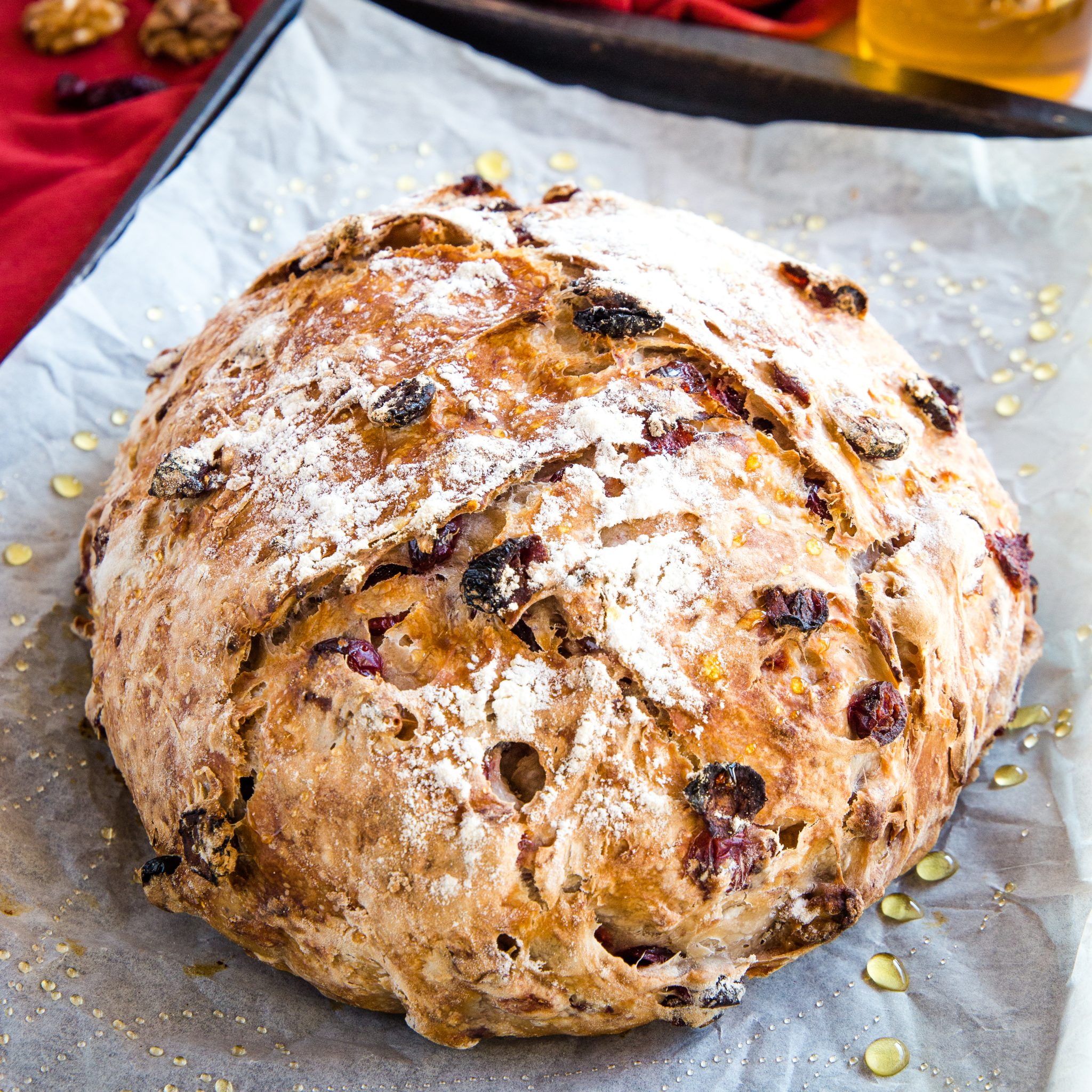
Recipe: Ingredients
- 3 cups all purpose flour, plus 3 tablespoons
- 1/2 teaspoon instant yeast
- 2 teaspoons sea salt
- 1/2 cup chopped walnuts
- 1 cup dried cranberries
- 1 1/2 cups water at room temperature
- 2 tablespoons liquid honey, plus more for brushing on after baking or other vegan honey substitute
Recipe: Instructions
- Start with a large bowl and a wooden spoon, and add your flour to the bowl. Measure the yeast and add it to one side of the bowl. Measure the salt and add it to the other side.
- Using a wooden spoon, stir the yeast into the flour on its side of the bowl first and then stir the salt into the flour on its side of the bowl. This will prevent the salt mixing directly with the yeast. Give the whole mixture a few good stirs to make sure everything is combined.
- Add the cranberries and walnuts to the flour mixture and toss well to coat, and to make sure they're distributed evenly throughout.
- Measure the water. Make sure the water is at room temperature; water that is too warm or too cold can kill the yeast and prevent the bread from rising at all. Add the honey to the water and stir with a fork to combine.
- Pour the water in and stir with a wooden spoon. The dough will be rough and a bit sticky, but that's normal.
- Stir until all the flour is combined. This is not normal bread dough (there's no kneading involved in this recipe), so you don't need to be too concerned about the appearance of the dough at this point. Just make sure the ingredients are combined well.
- Cover the bowl with plastic wrap. It's a good idea to ensure there's adequate space left in the bowl for the dough to at least double in size. Place the bowl in a warm, draft-free place and let it rise for 12-18 hours.
- After the dough has risen for 12-18 hours, preheat your oven to 425 degrees Fahrenheit (if you're using convection, 410 degrees. If your oven runs hot, 400 degrees). Place your Dutch oven with the lid on in the cold oven and let it heat up with the oven. If your dutch oven is black or dark-coloured on the inside, set your oven to 400 degrees Fahrenheit instead of 425. I recommend a 6 or 7-quart dutch oven for this recipe.
- Place a piece of parchment paper on the counter and dust it with flour so the dough doesn't stick to the paper. Rub flour on your hands and scrape the dough away from the sides of the bowl, gathering it in your hands as best you can (it may feel kind of fluid and not at all like regular bread dough) and forming it into a circular loaf on the parchment paper. Don't worry if it still looks a little rough in places - this lends to the rustic look of this loaf. If your dough is very fluid, simply add an extra 1/4 to 1/3 cup of flour to the dough as you shape it.
- Once you have it shaped, the dough needs to undergo a second rise (much shorter than the first). The goal is to handle the dough as little as possible at this stage because any amount of tugging at the rough can cause it to deflate after it has undergone its second rise. The next few steps will help prevent this. But don't worry if it deflates a bit. This bread dough is pretty forgiving.
- Sprinkle flour over the top of the loaf and loosely cover it with plastic wrap to prevent a skin from forming over the dough. The flour also prevents the plastic wrap from sticking to the dough so when you take it off at the end of the rise, it doesn't disturb the dough and wreck the rustic shape you've created. Let the dough rise for about 45 minutes. Your oven will also be preheating during this time (and so will your pot).
- Once 45 minutes have passed remove the plastic wrap from the dough and trim the parchment paper into a circle closely around the dough. If it doesn't look like the dough has risen that much, don't worry about it. The loaf will puff up a bit when it hits the heat of the oven.
- Remove the preheated pot from the oven and transfer the dough into the pot as carefully as possible by handling only the parchment paper. Place the lid on the pot and return it to the oven for 30 minutes. Don't open the oven during this time, and certainly don't take the lid off the pot; the crispness of the crust develops because of the steam that builds up in the pot during this 30 minutes.
- After 30 minutes have passed, remove the lid from the pot and continue baking for another 15 minutes. After the 15 minutes have passed, remove the pot with bread from the oven and place it on a wire rack to cool. You'll probably hear it crackling as it cools - this is normal. Brush a little extra honey on the top of the bread now, if desired.
- If you can, resist the urge to cut into the bread until it has pretty much cooled completely. The bread continues to bake on the inside even after it has been removed from the oven and cutting it too early could result in the inside becoming gummy or rubbery.
Recipe: Notes
Quick rise method:
- Add 2 1/2 teaspoons of active dry yeast instead of the amount listed in the recipe.
- Rise for 2 hours and follow the recipe directions after the rise time as written.
No Knead Bread Troubleshooting Tips:
- If you find your dough is too wet and fluid, add an extra 1/3 cup all purpose flour and stir until a shaggy dough appears. The dough should be slightly sticky but not wet. You can do this after the first rise as well, before you shape the loaf.
- Add 1 tablespoon of Vital Wheat Gluten to the dough with the flour to create a very voluminous dough that rises beautifully every single time and isn't too dense (optional).
- I recommend a 6 or 7-quart dutch oven for this recipe, but any covered pot that's oven-safe can be used for this recipe.
- If the bottom crust of your bread burns or becomes too hard or tough, it's likely that the bottom burner of your oven is too hot OR you're using a pot that's black on the inside (these conduct heat more efficiently than one that's a light colour on the inside). Try lowering your oven temperature by 25 degrees, using the convection setting, or using a different pot that's light in colour on the inside.
- Every person's oven is different, so it's a good idea to check on this bread about 15 minutes into the baking time if you know your oven runs hot, if you're using a gas oven, or if you are using the convection setting.
- Use an oven thermometer to make sure your oven temperature is correct. If your oven runs hot, lower the temperature of your oven by 25 degrees to be sure you don't burn the bread.
- Don't forget to dust the bottom of your pot with flour, or dust the parchment paper with flour (if you're using parchment paper as directed) so the bread doesn't stick.
- During the last 15 minutes of baking if you notice the bread is becoming too brown simply remove it from the oven early.
Recipe: Nutrition
Notice: Nutrition is auto-calculated, using Spoonacular, for your convenience. Where relevant, we recommend using your own nutrition calculations.
So I just mixed the dough following the recipe to a T, but my dough looks like cake batter. I’ve double and triple checked the measurements. Is this right? I’m so confused. I’m about to set it to rise but I’m concerned something isn’t right. Help! Thanks!
It sounds like your dough is too wet. I’d suggest adding a little bit more flour until a shaggy dough forms.
Can I use dough starter since I can’t find any yeast anywhere and if so what is the equivalent of (1) tsp as called for in the recipe? Thank you.
Unfortunately I can’t say as I don’t use dough starter. Best of luck!
Mine came out very dark on the outside and I followed the instructions to a T. Any advice on how to prevent that? Bake less with the lid off maybe?
I’d recommend lowering your oven temperature.
This is a great recipe that everyone loves. I just want to suggest
That if you have an Instantpot, you can prove the dough in that
For 4 hours on the low yogurt setting……and then you can eat it
The same day!! Just continue on after the 4 hours with step 8.
Thanks for the recipe!
Thanks for the idea Barb!!😊
Absolutely delicious. It looked professionally made.
Thanks Carol!! Glad you like it!🙂
This looks fabulous! I’m a bread novice, so wondering if I halved the recipe, would I need to adjust the cooking time? Thanks!,
Yes, you would need to adjust it a bit but i couldn’t tell you exactly how much because my family likes this bread so much that we always eat the whole thing!
Is the bread dough made with 3 cups and 3 tablespoons of flour or are the 3 tablespoons of flour used for dusting the loaf on the second rise?
All the flour goes into the recipe. You can use extra for dusting on the loaf. 🙂
I loved this, it was so easy to make.
I don’t own a durch oven, so I used a baking dish that I have, that comes with a lid and it worked just fine.
Thanks for the recipe, since I don’t have bread maker, this is perfect!
Thanks so much for the feedback! Really happy to hear that it turned out perfect!🙂
How come mine came out tasting bitter.
Could it be the cranberries you used?
I am not an experienced bread makers but just had to try this bread. My bread did not rise as much as expected. Should I put it in my oven to proof (obviously not on)? I just sat it on top of the oven overnight and it rose some but not much. The finished bread got very dark, almost burnt in places, I even pulled it out a few minutes early. Any suggestions for an inexperienced bread maker?
Your oven might run a little hot. Try lowering the temperature a bit: 25 degrees under what the recipe calls for. As for raising, the dough is not supposed to raise a lot outside of the oven, just make sure your kitchen is not drafty and you should be good! Have fun baking!
Made this 2 times now. It is amazing. My top was more brown the second time I made it which I thought was odd so I just put it in for 10 minutes without the lid. The bottom was black but I forgot about the suggestion of the trivet. I will try that next time. You cant even imagine how impressed I am with myself. Thank you so very much for making me look good.
Glad to hear you liked it so much! Thank you Candace!
My first try making this resulted in a flat and gummy loaf. The taste was great and the crust was unbelievable but I made an error in using traditional active dry yeast instead of instant or rapid rise yeast. My second try is in the proofer right now and I will let it rise for 16 hours before I move to the next step. I noticed this second try the dough is not any where near as wet as the first try. I agree, photos of the dough appearance at each step would be very helpful! Both times I added grated orange zest. I’m not 100% clear whether you remove the bread from the Dutch oven when cooling it on the wire rack. My first try I removed it (thinking the crust would get soggy if I left it to cool inside the dutch oven. Fingers crossed this second attempt is the bomb.
Great bread!!!!!! Definitely a must try
Thank you Lana!!
The bottom was burned and the top, but the top was tolerable. The inside was gummy but I did cut into the bread before it was completely cooled. I have a electric oven but it is not a convection oven. I used 2 cups bread flour and 1 cup AP flour. I followed the recipe exactly it raised fine etc.
I have made artisan bread before but not with honey or any other sweetener I’m wondering if the honey makes this bread burn easier then the other recipes.
Any ideas?
It sounds like your oven’s burner might be on the bottom. Does your oven have an option to use a top and bottom burner? This would give a more even heat. This recipe definitely works best on a convection setting or a more even heat setting.
This looks delicious I can’t wait to make it. I’ve read ALL the comments and have picked up some goods tips,my question is can I use a 7 at. Dutch oven? Will the loaf be too flat or should I double the recipient?
Yes, you can use a 7 quart dutch oven.
I just made this and it is so amazing! Tastes like bread from a fancy artisan bakery. I even miss read the directions and missed the honey part (only rubbed some on the end when it was done) and thought I messed it up…nope. It was awesome! Can’t stop eating it. Thank you!
Really happy to hear it still turned out well and you enjoyed it! Thank you!
I am about to try this recipe! Sounds wonderful! Do I use 3 cups flour and 3 Tablespoons of flour in the recipe or is the 3 Tablespoons to put on top of the bread before I bake it?
The 3 cups plus 3 tablespoons is added to the bowl right at the beginning. 🙂
Absolutely The Best! Great Recipie, effect for the Holiday Season!
Thank You!!
So glad you love it! 🙂
I really want to master this – any ideas as to why my loaf was heavy and dense, almost wet, on the bottom (the bottom inch or so)? I followed the instructions to a t. I wonder though if it was too warm while rising? Thanks!
It sounds like that could be the case, or perhaps you added too much liquid to the recipe.
Great recipe and has become a family hit. Thank you.
A question. I would like to split the dough and make two smaller loafs. Can you recommend cooking time adjustment if any?
I wouldn’t recommend splitting the dough, although if you do cutting the time in half would be a good place to start.
I just finished making my first loaf and went exactly by the recipe, including oven temps. Not only did my loaf burn on the bottom, the top is also overdone. I am very disappointed in the results of this recipe. I have a standard electric oven with the heating coils on the top, and had the Dutch oven in the center.
I want to make this bread for Christmas, but will be looking for another recipe. Too much time goes into this for such a bad result.
Sorry it didn’t work for you…did you try the convection setting on your oven? Also, what kind of dutch oven did you use?