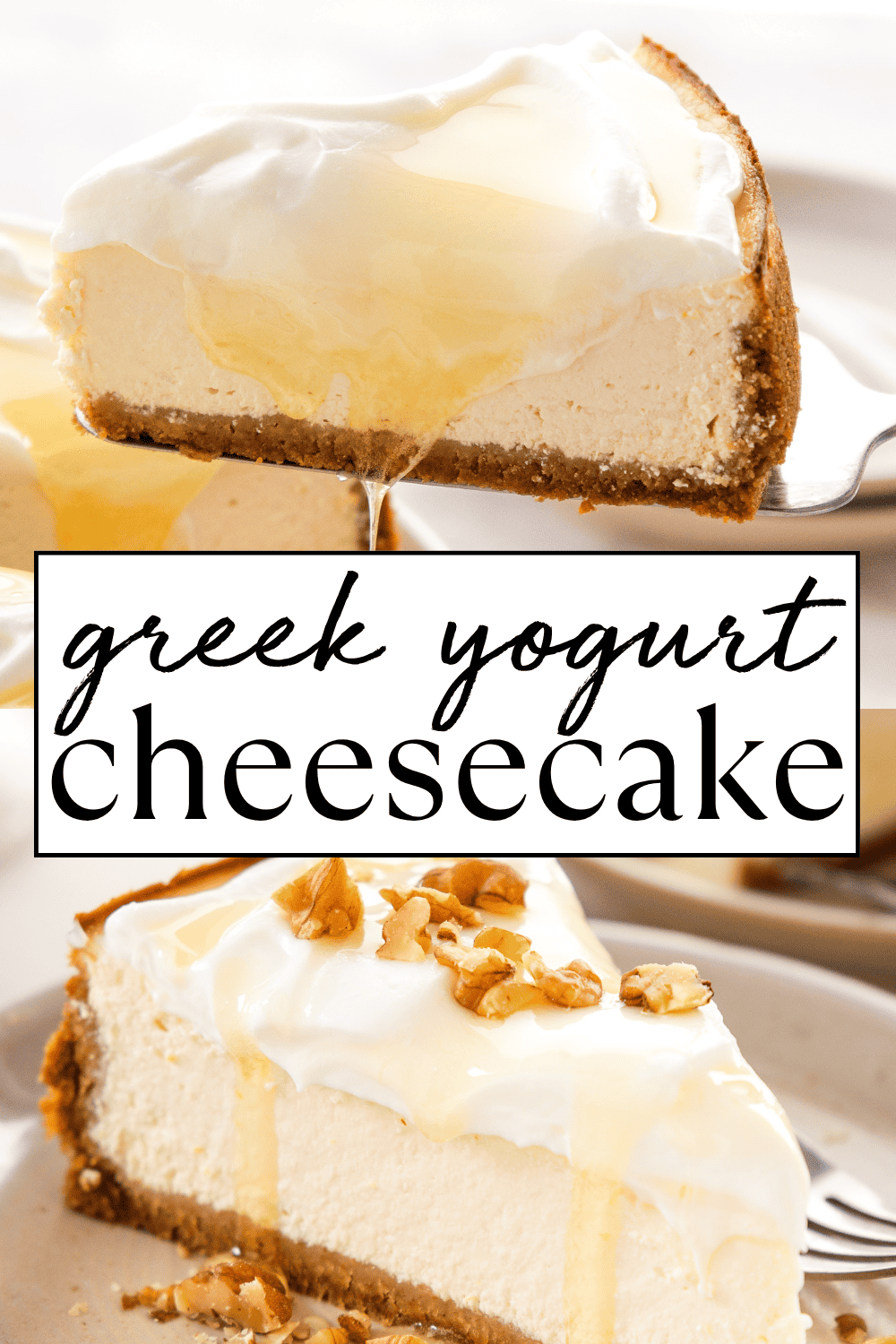
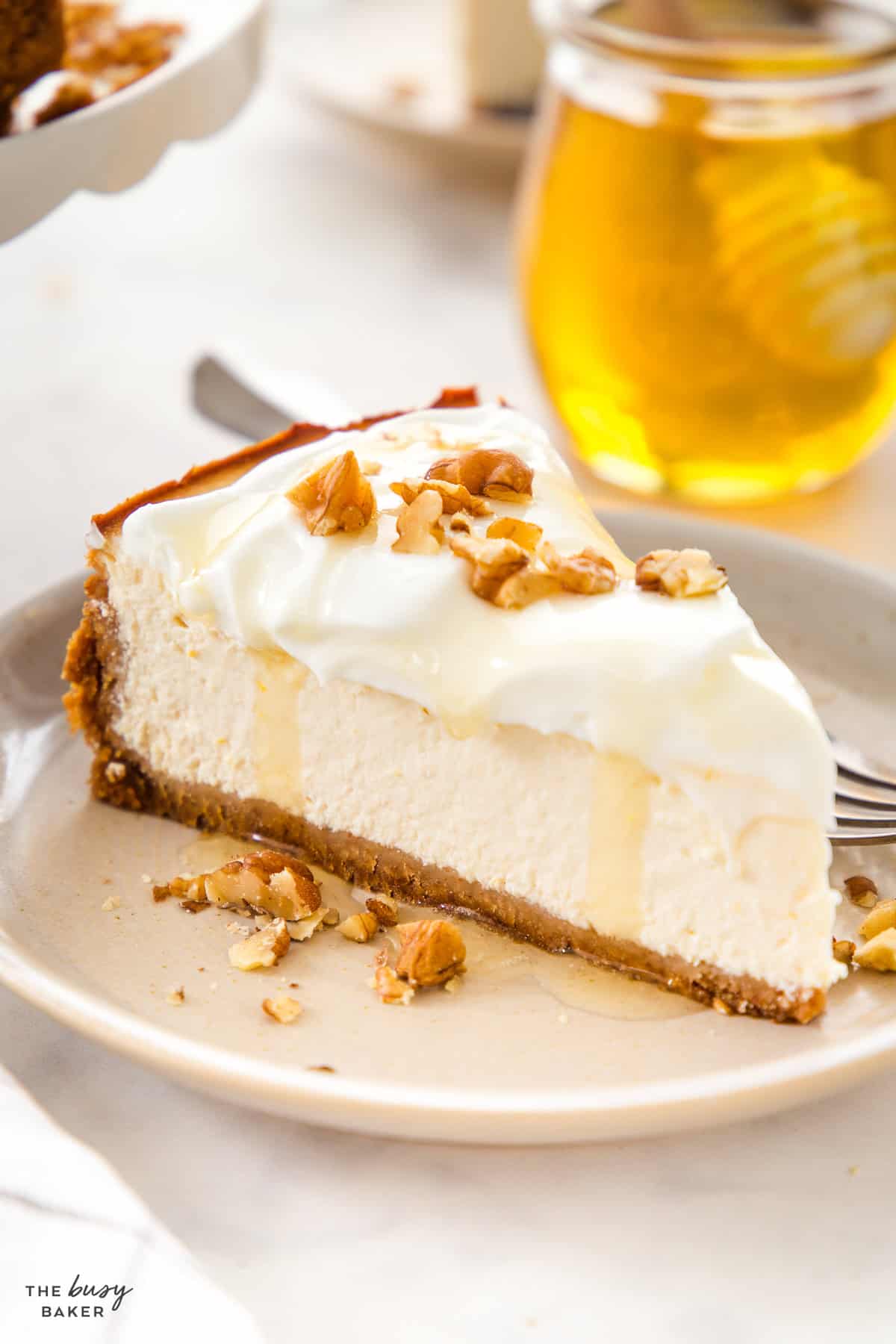
A healthy Greek yogurt cheesecake made with ricotta, sweetened with honey, and finished with a simple honey walnut topping. No water bath, no refined sugar, and an ultra creamy cheesecake texture without the added calories.
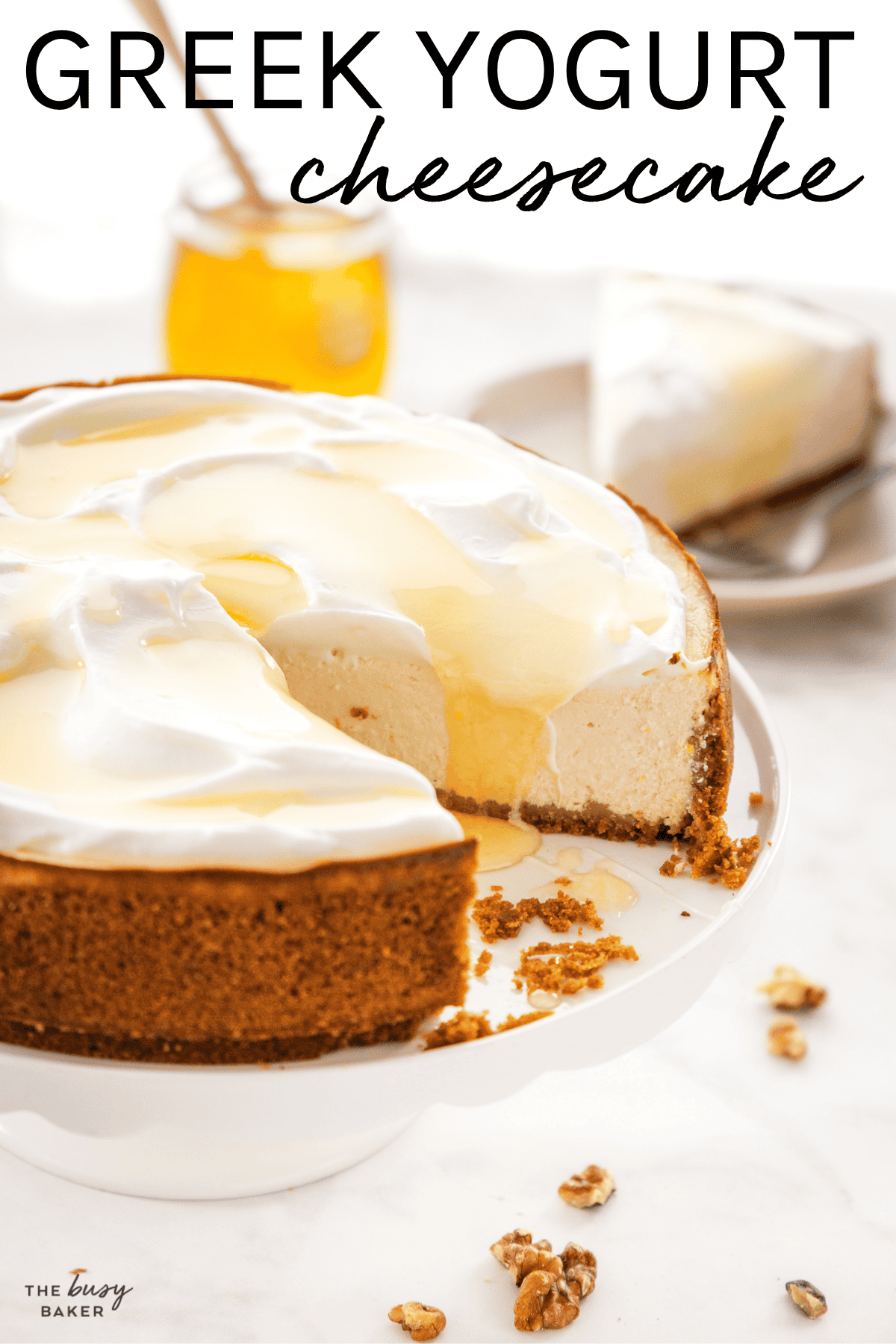
This cheesecake is my go-to when I want something that feels celebratory but doesn’t leave me regretting the second (or third) slice. It’s a Greek yogurt cheesecake built on a base of strained yogurt and ricotta, sweetened with honey, and finished with a quick whipped cream, honey, and walnut topping that’s Mediterranean-style.
I’ve been making this recipe for many years, and it never disappoints. It’s tall, so creamy, and absolutely hits the spot when you’re craving a slice of cheesecake. And the whipped cream, honey, and walnuts as the topping take it to the next level!
If you’ve been looking for a healthy cheesecake recipe that still tastes like cheesecake, THIS is the one! It’s the kind of dessert I’ll happily serve at a Sunday lunch or take to a friend’s house, and nobody ever guesses it’s refined sugar-free!
- The Greek yogurt + ricotta base, instead of cream cheese. Most “healthy” cheesecakes swap cream cheese for yogurt and they end up loose and watery. The ricotta gives you the body that cream cheese normally provides, and the strained Greek yogurt gives you the tang. You get the texture of a baked cheesecake without the calorie load.
- Sweetened with honey, not refined sugar. Honey carries the flavour better with the yogurt’s natural tang, and it goes well with the walnuts on top.
- No water bath. A lot of baked cheesecakes ask you to wrap your pan in foil and float it in a roasting tray of hot water. This one doesn’t. The yogurt and ricotta base is more forgiving than a classic cream-cheese filling, so a gentle bake at a moderate temperature gives you a smooth top without the production.
- One bowl, one springform pan, and no fancy equipment. A hand mixer or even a whisk and a sturdy arm will do it. No stand mixer required.
This is the single most important step. Set the yogurt and ricotta mixture in a fine-mesh sieve lined with cheesecloth (or a clean tea towel) over a bowl in the fridge for at least 8 hours, ideally overnight. You’ll pull out a surprising amount of liquid, and that’s exactly what would otherwise make your cheesecake watery.
Low-fat versions will work in a pinch but the texture will suffer. Full-fat is what gives you that proper cheesecake mouthfeel.
Cold yogurt and cold eggs don’t blend smoothly, and you’ll end up with little white streaks in the batter. Pull everything out of the fridge 30 minutes to an hour before you start.
Mix just until combined. Over-beaten eggs incorporate too much air into the cheesecake batter and that’s a big cause of the cracks that show up later.
The centre should still have a gentle wobble when you pull it out, like a softly set custard. It will firm up as it cools.
A sudden temperature change is the second biggest cause of cracking. Turn the oven off, crack the door, and let the cheesecake sit in the cooling oven for 20 minutes before pulling it out to finish on the counter.
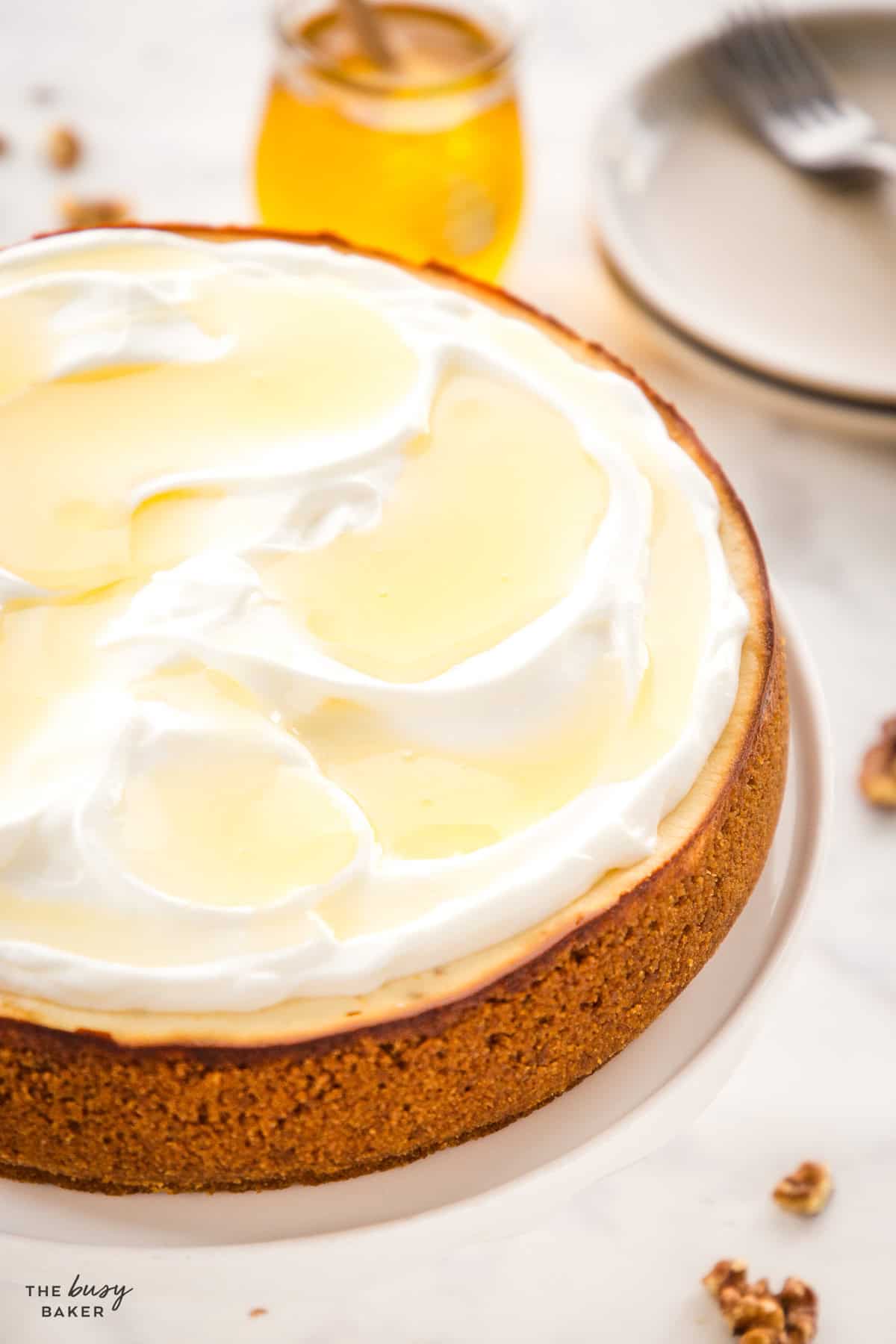
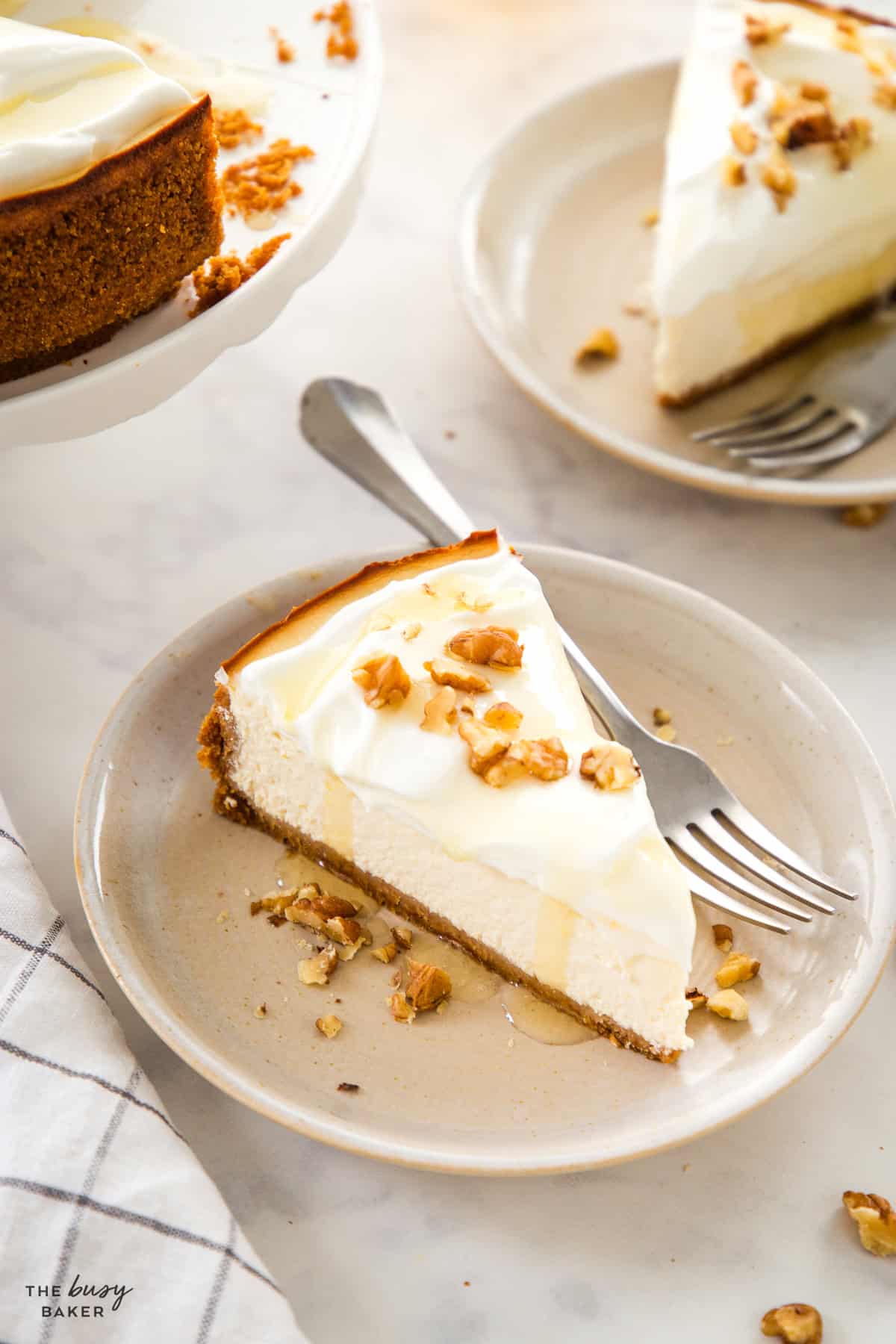
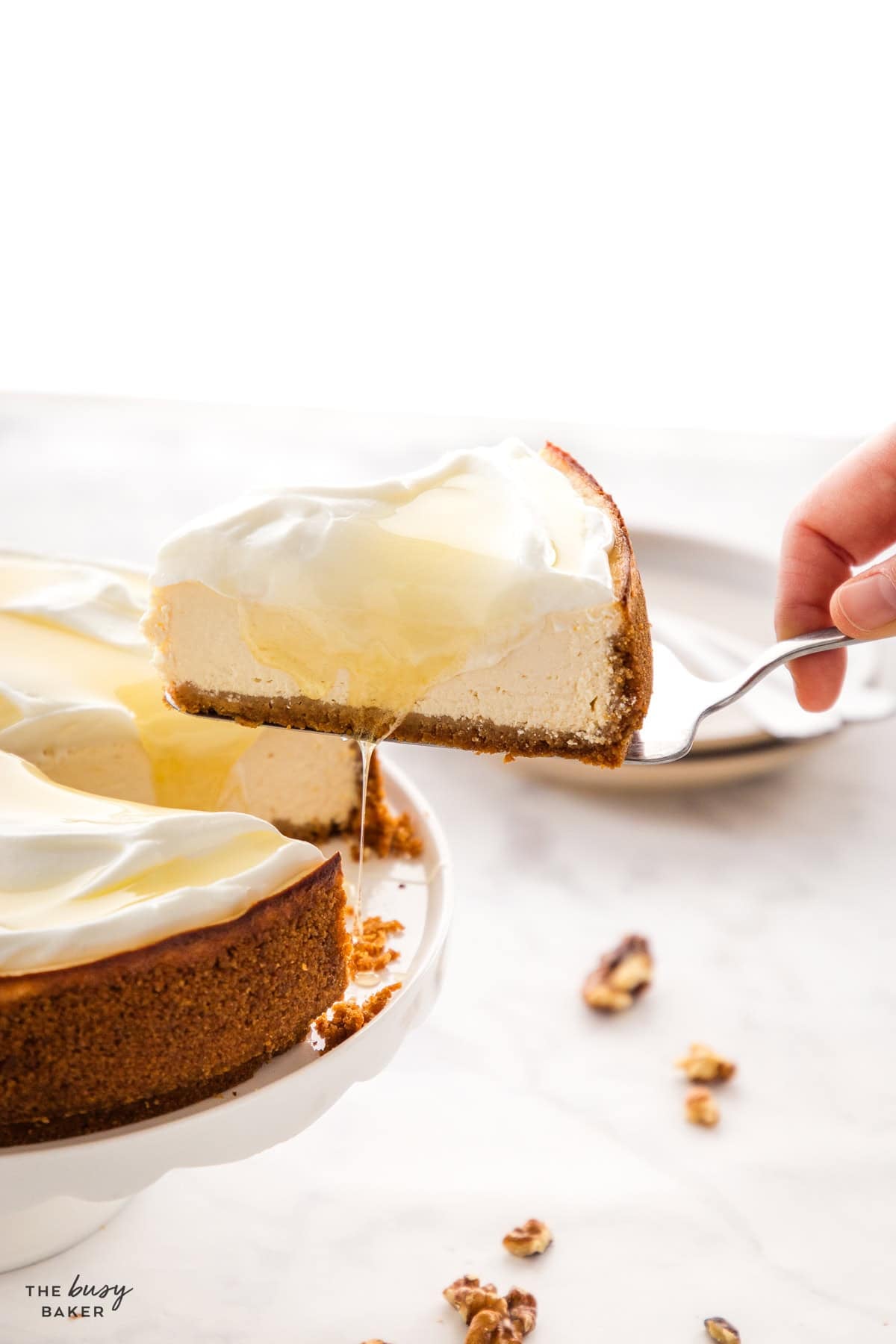
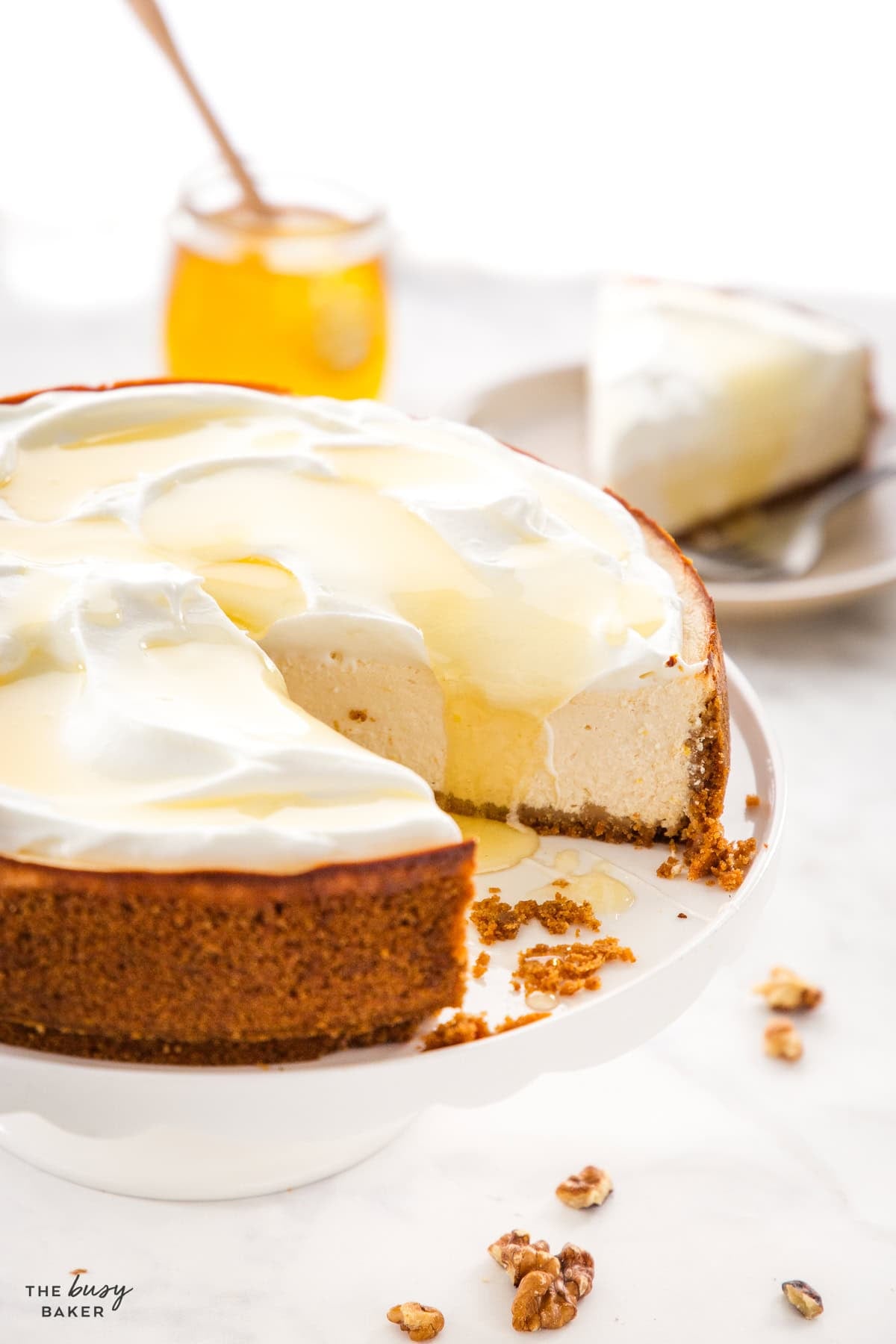
The whipped cream, honey drizzle and walnuts go on right before you serve so the walnuts stay crisp and the honey looks fresh. If you top too far ahead, the walnuts soften and the honey soaks in.
The night before
Combine the Greek yogurt and ricotta in a bowl and then strain the mixture in a cheesecloth-lined sieve set over a bowl. Cover and refrigerate overnight. You’ll lose a good amount of liquid, and what’s left in the sieve is what you want to use in the recipe.
Make the crust
Stir the graham cracker crumbs with the melted butter until the mixture looks like wet sand. Press it firmly and evenly into the bottom of a 9-inch springform pan, working the crumbs slightly up the sides if you like a small lip. Set the crust aside.
Make the filling
In a large bowl, beat the strained Greek yogurt and ricotta together until smooth. Add the honey, lemon zest, and vanilla, and beat again. Add the eggs one at a time, beating just until each one is incorporated. Stop mixing as soon as the filling is smooth – this is where over-mixing causes cracks.
Bake
Pour the filling over the crust and gently smooth the top. Bake at 325 degrees Fahrenheit (165 degrees Celsius) for 55 to 65 minutes, until the edges are set and the centre still has a gentle wobble. Turn the oven off, crack the door, and leave the cheesecake inside for 20 minutes. Then move it to the counter to finish cooling to room temperature.
Chill, then top
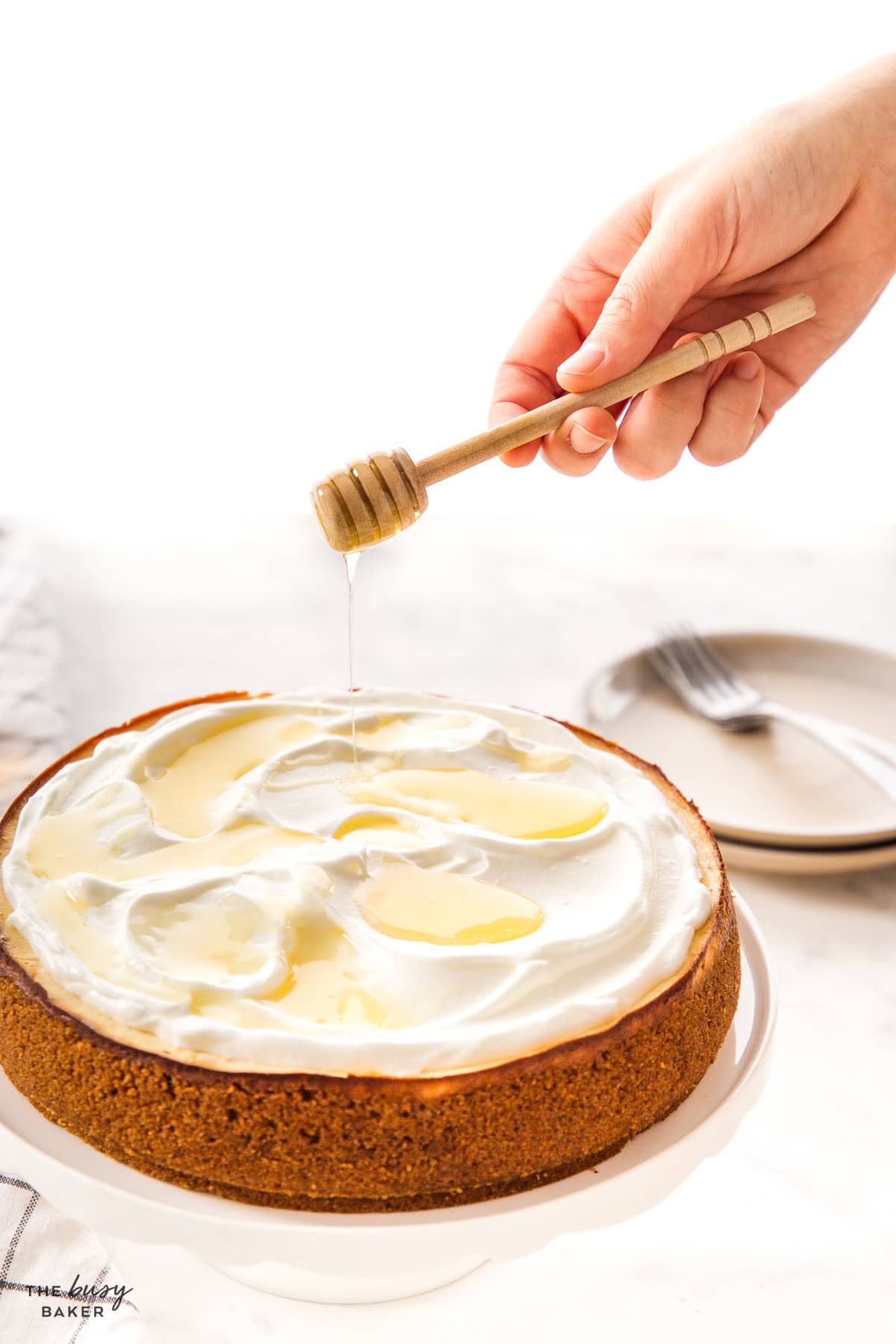
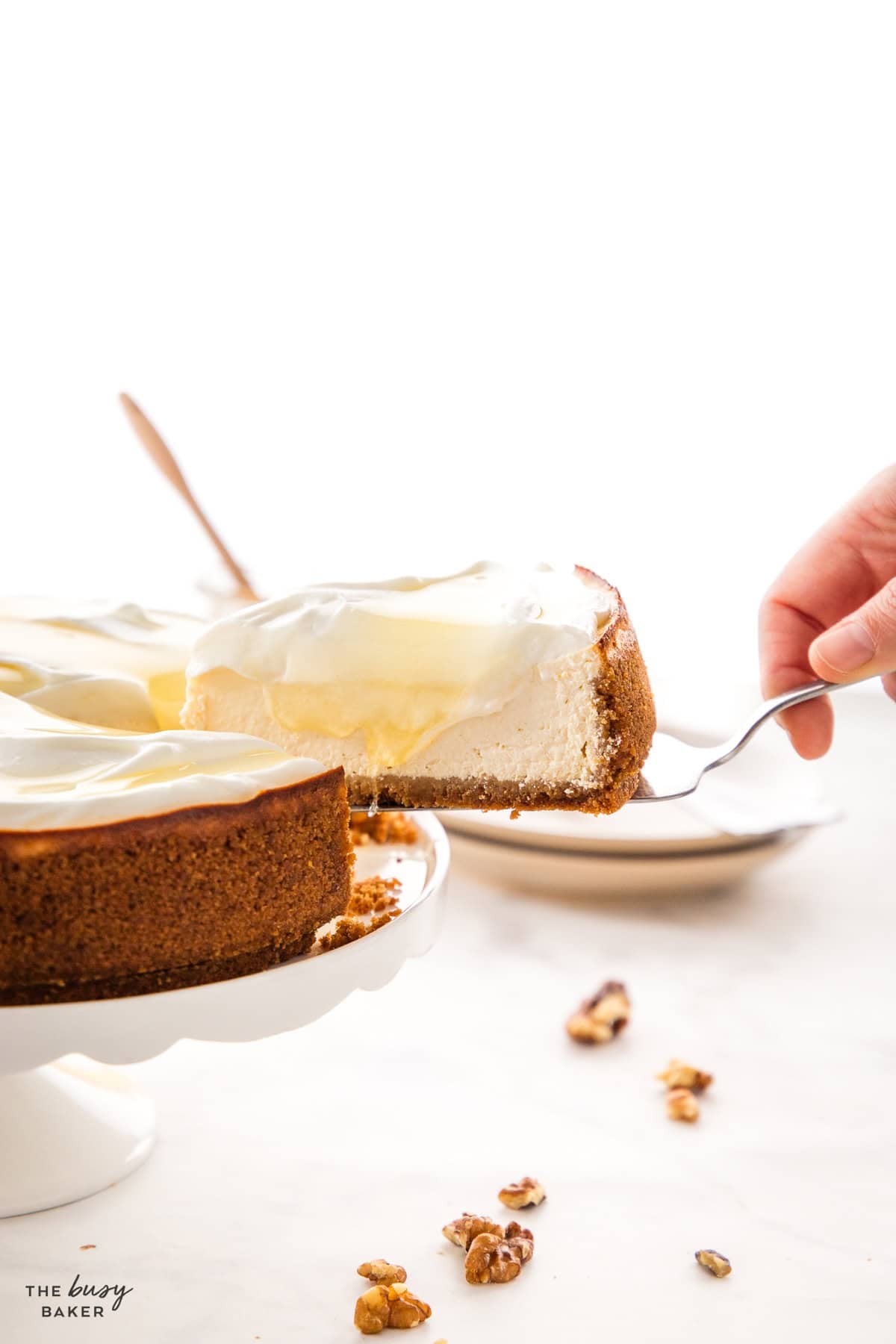
Refrigerate the cooled cheesecake for at least 4 hours, ideally overnight. When you’re ready to serve, run a thin knife around the edge and release the springform pan. Pipe or dollop whipped cream around the top (optional), drizzle generously with honey, and scatter chopped walnuts over the top. Slice and serve.
- Use Quark instead of ricotta. A reader from Europe pointed out that Quark is the closer match to what this filling is doing, and they used 4 cups of Quark in place of the yogurt + ricotta combo. If you have access to Quark, that swap works beautifully.
- Use digestive biscuits for the crust. Outside North America, digestive biscuits are the closest match to graham crackers. Use them at a 1:1 swap by volume of crumbs.
- Gluten-free. Use gluten-free graham crackers or gluten-free digestive biscuits in the crust. The filling is naturally gluten-free.
- Lemon-y version. Double the lemon zest and add 1 tablespoon of fresh lemon juice to the filling. Skip the honey drizzle and finish with a thin layer of lemon curd instead.
- Fresh fruit topping. Skip the walnut topping and pile macerated berries over the top (strawberries, raspberries, or a mix), with a little honey instead of sugar to bring out the juices.
- Mini cheesecakes. Press the crust into a 12-cup muffin tin lined with paper liners, divide the filling between the cups, and bake at 325 degrees Fahrenheit (165 degrees Celsius) for 18 to 20 minutes. Top after chilling.
- A Mediterranean-style dinner. This cheesecake leans Mediterranean in the topping, so it pairs naturally with a meal in that direction. A Greek yogurt marinated chicken main with a big Greek-style salad makes the through-line obvious.
- Summer entertaining. Serve it cold, straight from the fridge, with a glass of dessert wine or a strong espresso.
- A light dinner party. Pair it with a roasted salmon main and a simple green salad for the kind of dinner that feels generous without being heavy.
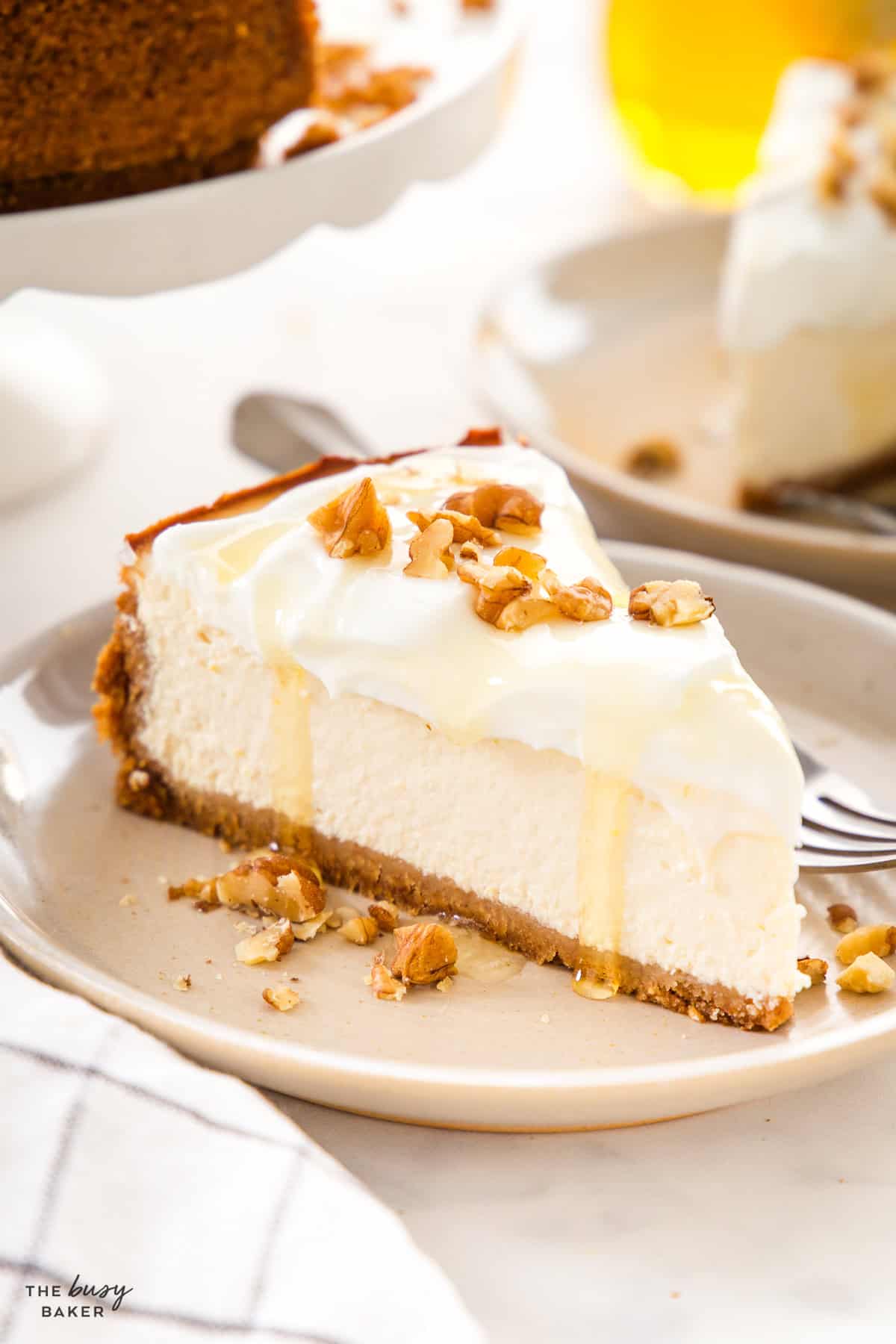
Store the cheesecake, covered, in the fridge for up to 4 days. If you’ve already topped it with honey and walnuts, eat those slices first – the walnuts soften over time. For best results, top only the slices you’re serving and keep the rest plain in the fridge.
To freeze, wrap the cooled, untopped cheesecake tightly in plastic wrap, then foil, and freeze for up to 2 months. Thaw overnight in the fridge before topping and serving. The texture holds up well to freezing as long as it was properly chilled first.
Does Greek yogurt curdle when you bake it?
No. Strained Greek yogurt baked in a custard-style filling like this one stays smooth. Curdling usually comes from very high heat or from adding cold yogurt to a hot mixture. Neither happens in this recipe.
Can I substitute Greek yogurt for cream cheese in a regular cheesecake?
Not as a straight swap. Greek yogurt has too much liquid and not enough fat to replace cream cheese 1:1. You need to either strain it heavily (as in this recipe) or pair it with something denser like ricotta or Quark.
Do I need a water bath for this cheesecake?
No. The yogurt + ricotta filling is more forgiving than a classic cream cheese cheesecake, and a slow oven cool-down does the same job a water bath would do for preventing cracks.
Why did my cheesecake crack?
There are three usual reasons for this: over-mixing the filling after the eggs go in (it incorporates too much air), over-baking (the centre should still wobble when you pull it out of the oven), or pulling the cheesecake out into cold room air too fast (let it cool gradually in the turned-off oven with the door cracked open first).
Can I make this the day before?
Yes. In fact, I prefer it. An overnight chill firms up the slice and the flavours mellow nicely. Just hold the topping until right before serving.
Can I skip the overnight straining step?
I really don’t recommend it. The straining is what makes the texture work. If you’re short on time, buy a thick Greek yogurt labelled “extra strained” and skim off any visible liquid on top before measuring, but a true overnight strain is best.
Can I use flavoured Greek yogurt?
I wouldn’t. Flavoured yogurts have added sugar and stabilizers that throw off the balance and the texture of the baked cheesecake. Plain, full-fat is the best choice.
What size pan should I use?
A 9-inch springform pan is best.

More Healthier Dessert Recipes You’ll LOVE
- Chocolate Fruit Dip
- Fruit Platter
- Fruit Salad
- Healthier Double Chocolate Baked Donuts
- No Bake Chocolate Mousse Cheesecake (Vegan and Dairy Free)
- Old Fashioned Powdered Sugar Baked Donuts
- Chocolate Covered Strawberries
If you made this, share a photo!
Are you trying this recipe? Use the comment form below to share your take; now with support for image uploads and comment voting!
Healthy Greek Yogurt Cheesecake with Honey and Walnuts
Recipe: Equipment
- cheesecloth
Recipe: Ingredients
For the crust
- 2 cups graham cracker crumbs
- 1/3 cup melted butter
For the filling
- 3 cups plain full-fat Greek yogurt strained overnight
- 3 cups full-fat ricotta cheese strained overnight
- 4 1/2 tablespoons honey
- 2 large eggs at room temperature
- 1 1/2 teaspoons pure vanilla extract
- zest of 1 1/2 lemons
For the topping
- 1 cup whipped cream optional
- 2 to 3 tablespoons honey for drizzling
- 1/2 cup chopped walnuts
Recipe: Instructions
- Combine the yogurt and the ricotta the night before. Place the Greek yogurt and ricotta mixture in a cheesecloth-lined sieve set over a bowl. Cover and refrigerate overnight to drain.
- Preheat the oven to 325°F (165°C). Stir the graham cracker crumbs with the melted butter until evenly moistened. Press firmly into the bottom of a 9-inch springform pan. Set aside.
- Make the filling. Let the yogurt and ricotta mixture sit at room temperature for 20-30 minutes before making the filling. Add the strained yogurt ricotta mixture to a large bowl along with the honey, vanilla, and lemon zest, and stir well to combine. Add the eggs one at a time, beating just until each one is incorporated. Do not over-mix.
- Bake. Pour the filling over the crust and gently smooth the top. Bake at 325°F (165°C) for 55 to 65 minutes, until the edges are set and the centre still has a gentle wobble.
- Cool gradually. Turn the oven off, crack the door, and leave the cheesecake inside for 20 minutes. Then move to the counter and let cool to room temperature.
- Chill. Refrigerate the cooled cheesecake for at least 4 hours, ideally overnight.
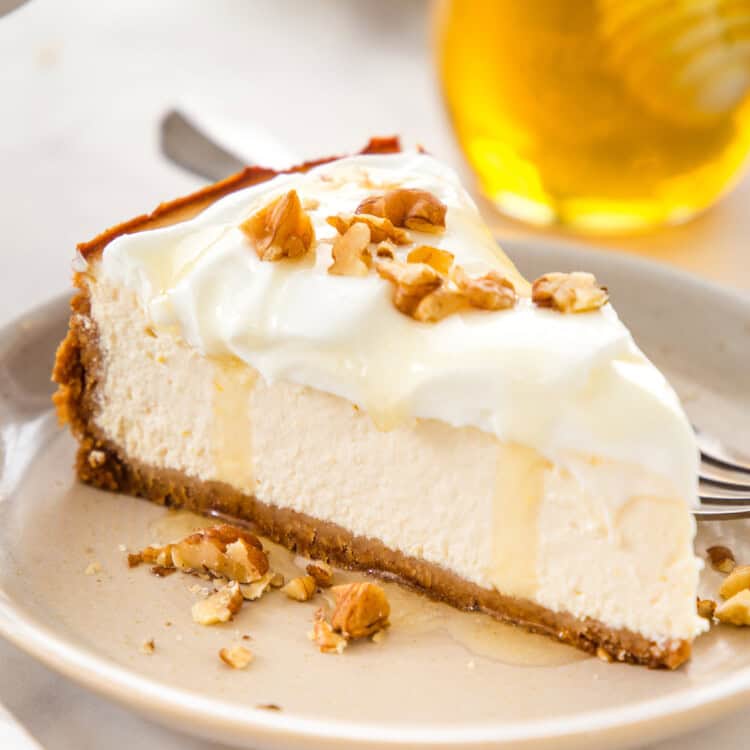
- Top and serve. Run a thin knife around the edge and release the springform pan. Top with whipped cream (if using), a drizzle of honey, and the chopped walnuts. Slice and serve.
Recipe: Notes
Recipe: Nutrition
Notice: Nutrition is auto-calculated, using Spoonacular, for your convenience. Where relevant, we recommend using your own nutrition calculations.
Thanks for this awesome healthy cheesecake recipe. I made it using Galbani Ricotta cheese & strained Farmer Union Greek Yogurt. It turns out so creamy & amazing. I cut e recipe into half to test out e recipe. Will defintely be making this for my staple cheesecake🙂. By e way, do u think I can add in 1 or 2tbsp of cornstarch to set e cheesecake? Would it affect the texture?
You could try adding cornstarch, although it may dry out the cheesecake texture a little too much.
I’ve made this with Greek Quark Yogurt rather than Ricotta and Greek yogurt, and it’s AMAZING!
Thank you for your recipe! I just used 4 cups of the quark yogurt rather than 2 and 2.
Thanks for the tip Shannon! Glad you like the recipe!
Hi Chrissie thank you for your recipe the greek yogurt cheesecake turned out amazing its just cause lam in Australia, l cant find those biscuits crumbs you used. So l grabbed other ones. Had to use more then 2 cups cause my cake base was bigger. What other biscuits can l use for the base. I had to use more butter and my base of cake wasnt crunchy or hard it was soft. The honey and walnuts are Amazing with this healthy cake. Could you please give me some feedback. Thank you
You can use any brand of digestive biscuits and crumble them in a food processor. As for the butter, don’t add more than the recipe calls for(adjusted to the amount of crumbs you use). Even if your base might look a bit dry in the begining, it will also get moisture from the cream cheese mixture as it bakes, and it will come out with the perfect texture. Happy baking! 😊
Can I use honey vanilla flavored Greek yogurt? Couldn’t find 2% plain.
Sure you can! Happy baking!
Hi, is it necessary to drain the ricotta cheese/greek yogurt mixture overnight or can I skip the overnight water drain and bake it longer at a lower temperature to get rid of the excess moisture?
I’ve never done this, so I can’t comment on how it would work. Sorry!
Can I substitute the riccota for cream cheese? I’m making a lactose free version and I can’t find lactose free ricotta.
Thanks!
Yes! 🙂
I’ve never made a cheesecake previously (and I LOVE cheesecake), and this recipe and instructions were so easy – I’m not a baker, by any stretch. I especially loved how it was lighter, not as sweet or rich like “normal cheesecake”; My family was not super impressed of course by that fact. That’s cool though, MORE FOR ME!!
Becca, thank you! I’m glad you liked my recipe so much!🙂
you cant make a recipe website and just put the same picture over and over again without the ingredients or procedures
Hi Rosie, the recipes are always on my site in full. Just check the big yellow box at the bottom of every blog post. There you’ll find the list of ingredients and instructions for each recipe. Cheers!
I’m making the healthy honey Greek Yogurt cheesecake. Can’t believe it only bakes for 30 minutes. Is that correct? It’ll barely be warm by then.
The baking time is correct, yes 🙂