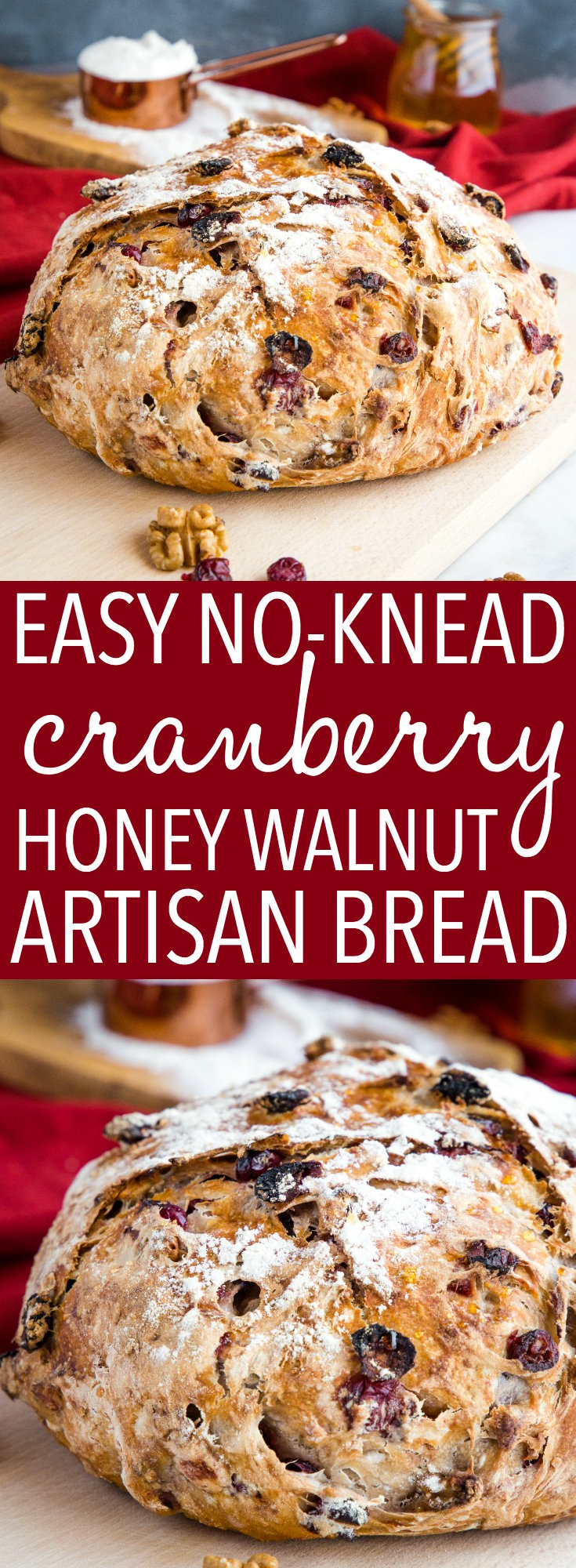
This No-Knead Cranberry Walnut Bread with Honey is a delicious bakery-style bread that’s sweet and delicious! Make it perfect with my easy pro tips for homemade bakery-style bread!
NEVER MISS A POST! FOLLOW ME ON:
FACEBOOK | PINTEREST | INSTAGRAM | TWITTER
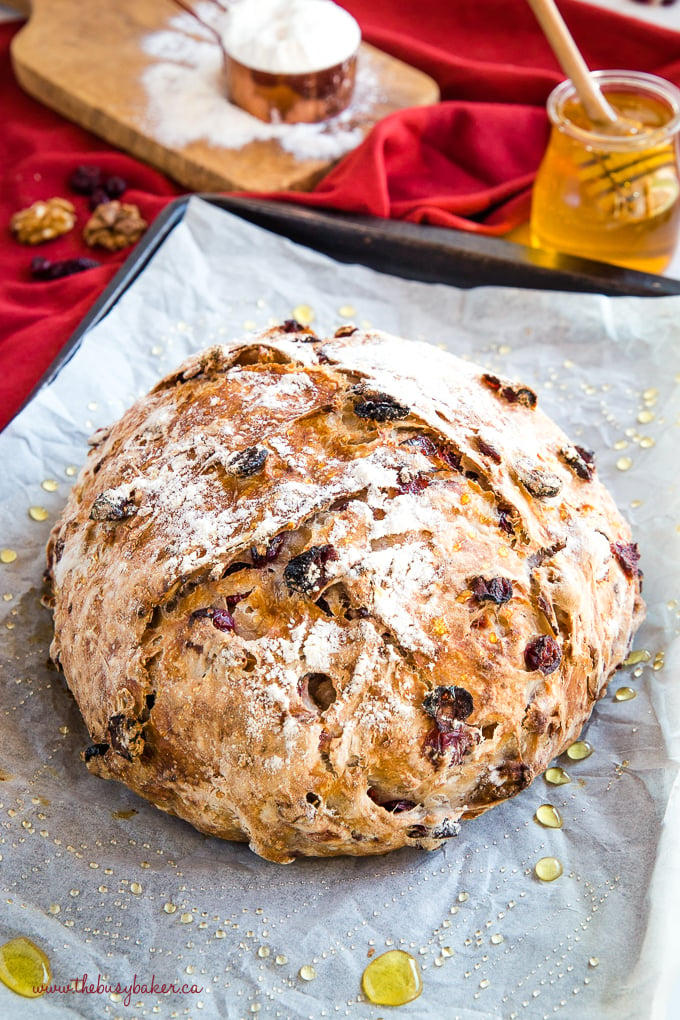
The BEST No-Knead Bread Recipe!
If you’ve been following thebusybaker.ca for awhile now you’ll already know how obsessed I am with no knead artisan-style bread recipes! Way back when I first started my blog I shared this Easy No Knead Artisan Bread recipe with you and it’s a recipe I’ve made more than a hundred times I’m sure, with countless flavour variations. My favourite variation yet is this No-Knead Cranberry Honey Walnut Artisan Bread! It’s delicious for breakfast or with a cup of tea in the afternoon, and it is a simply gorgeous loaf of bread that everyone will love, especially for the holidays! And with my pro tips, you’ll be able to make it too!
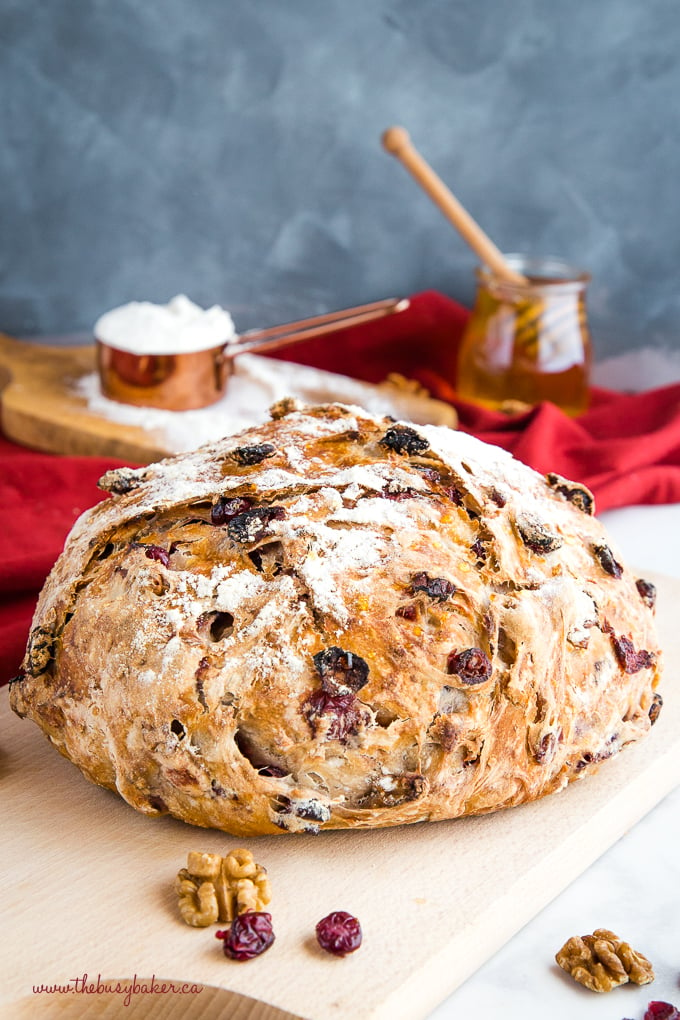
How to make Cranberry Walnut Bread
Pro tip#1: Pre-heat your Dutch Oven pot before baking.
This bread is baked in an oven-safe Dutch Oven pot which traps in steam, making the crust of the loaf extra crispy. Pre-heating the pot before baking helps make the crust even more crispy and golden brown! If you’re looking for a great Dutch Oven pot for making bread recipes like this No-Knead Cranberry Honey Walnut Artisan Bread, I will tell you that it’s one of the best investments you can ever make for your kitchen. Mine is a total beauty from Le Creuset (affiliate link) and I use it almost ever day throughout the year for soups, stews, sauces, curries, and of course for baking bread (if you want my original Dutch Oven Crusty Bread recipe, grab it HERE!). A pot like this one is definitely a financial investment, but considering how much I use mine and considering its high quality, it’s definitely a worthy investment since it will last for 10, 20 or even more years. I’ve also used similar cast iron pots from other brands, like THIS ONE from KitchenAid and THIS ONE from Lodge Cast Iron (both affiliate links) if you’re looking for something a little less expensive but still high quality that’ll do the job well.
EASY NO-FAIL HOMEMADE BREAD RECIPES AND BAKING TIPS
Get my easy no-fail bread baking e-cookbook!
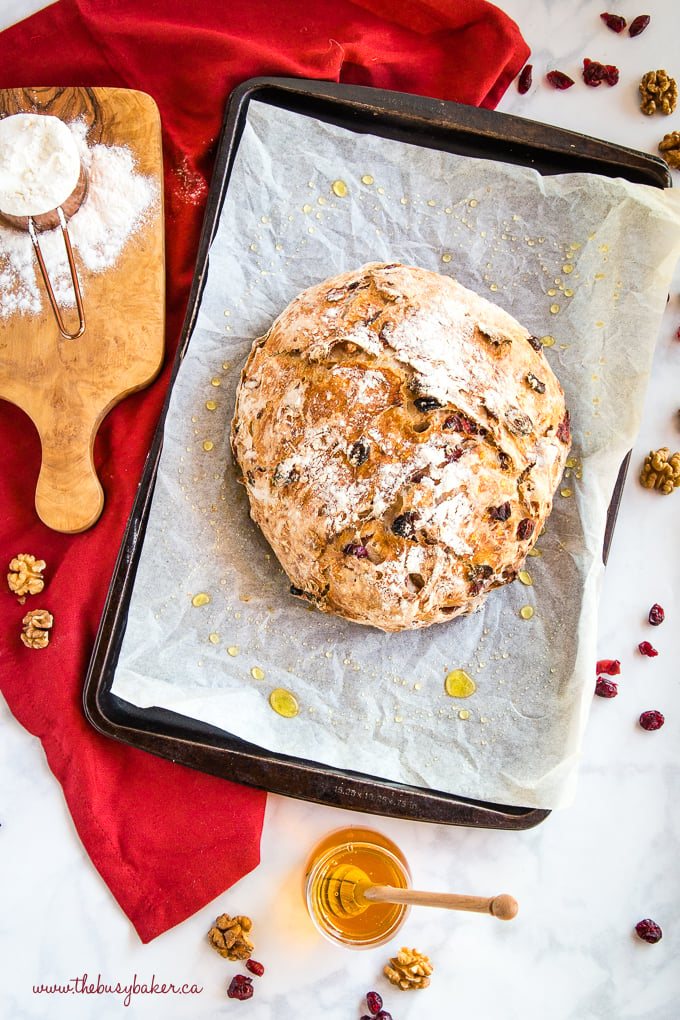
Pro Tip #2: Shape your loaf firmly but gently and dust the top of the loaf with flour.
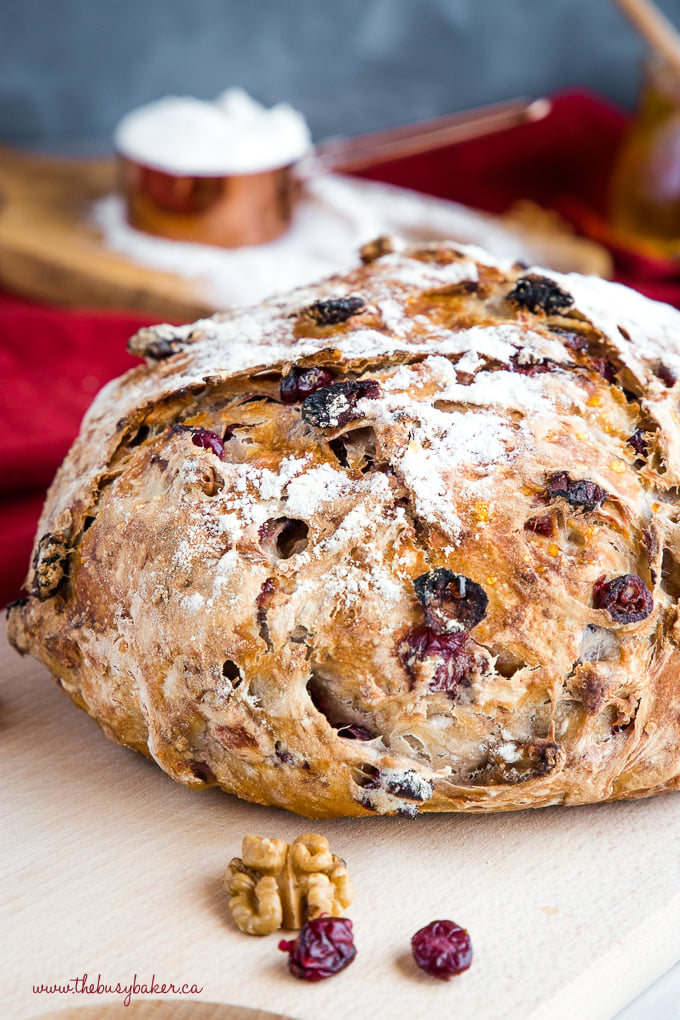
Creating a round shape will help the loaf bake evenly and dusting the top with flour will create that gorgeous, bakery-style appearance that everyone loves!
Pro Tip #3: Let the No-Knead Cranberry Honey Walnut Artisan Bread loaf cool completely before cutting into it!!
Resist the urge to slice the bread while it’s hot. Did you know that after removing a loaf of bread from the oven it continues to bake inside as it cools?? Slicing into this gorgeous loaf too early will cause the inside of the loaf to be under-cooked and gummy. Letting the loaf cool completely before slicing ensures the perfect fluffy texture when you slice into it!
NEVER MISS A POST! FOLLOW ME ON:
FACEBOOK | PINTEREST | INSTAGRAM | TWITTER
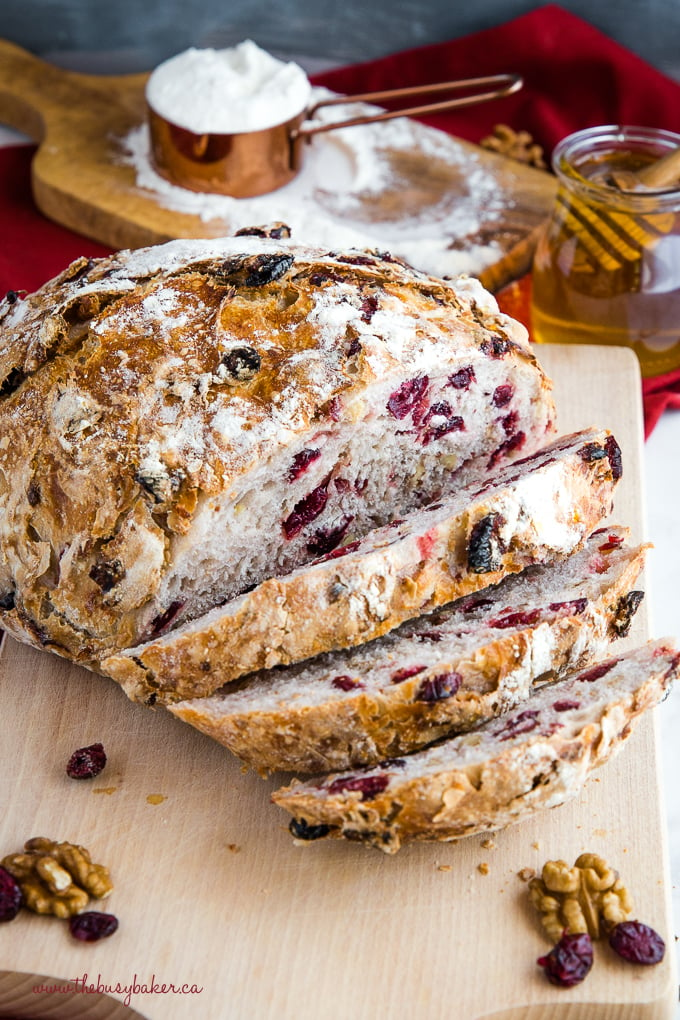
I hope you love this No-Knead Cranberry Walnut Bread with Honey as much as we do! Let me know in the comments below, what’s your favourite bakery-style bread to make at home? I’d love to know!
KITCHEN PRODUCTS I RECOMMEND:
Looking for even more delicious bread recipes? You’ll LOVE these:
-
Garlic Butter Dinner Rolls
-
Healthier Cornbread
-
Pumpkin Cornbread Muffins
-
Easy No Knead Artisan Bread
-
Easy No Knead Cinnamon Raisin Artisan Bread
EASY NO-FAIL HOLIDAY RECIPES AND COOKING & BAKING TIPS
Get my easy no-fail holiday meals e-cookbook!
RECIPE VIDEO
Watch the video below to see exactly how I make this delicious bread recipe. You can find more delicious recipe videos on my YouTube channel.
If you made this, share a photo!
Are you trying this recipe? Use the comment form below to share your take; now with support for image uploads and comment voting!
No-Knead Cranberry Walnut Bread with Honey
Recipe: Ingredients
- 3 cups all purpose flour, plus 3 tablespoons
- 1/2 teaspoon instant yeast
- 2 teaspoons sea salt
- 1/2 cup chopped walnuts
- 1 cup dried cranberries
- 1 1/2 cups water at room temperature
- 2 tablespoons liquid honey, plus more for brushing on after baking or other vegan honey substitute
Recipe: Instructions
- Start with a large bowl and a wooden spoon, and add your flour to the bowl. Measure the yeast and add it to one side of the bowl. Measure the salt and add it to the other side.
- Using a wooden spoon, stir the yeast into the flour on its side of the bowl first and then stir the salt into the flour on its side of the bowl. This will prevent the salt mixing directly with the yeast. Give the whole mixture a few good stirs to make sure everything is combined.
- Add the cranberries and walnuts to the flour mixture and toss well to coat, and to make sure they're distributed evenly throughout.
- Measure the water. Make sure the water is at room temperature; water that is too warm or too cold can kill the yeast and prevent the bread from rising at all. Add the honey to the water and stir with a fork to combine.
- Pour the water in and stir with a wooden spoon. The dough will be rough and a bit sticky, but that's normal.
- Stir until all the flour is combined. This is not normal bread dough (there's no kneading involved in this recipe), so you don't need to be too concerned about the appearance of the dough at this point. Just make sure the ingredients are combined well.
- Cover the bowl with plastic wrap. It's a good idea to ensure there's adequate space left in the bowl for the dough to at least double in size. Place the bowl in a warm, draft-free place and let it rise for 12-18 hours.
- After the dough has risen for 12-18 hours, preheat your oven to 425 degrees Fahrenheit (if you're using convection, 410 degrees. If your oven runs hot, 400 degrees). Place your Dutch oven with the lid on in the cold oven and let it heat up with the oven. If your dutch oven is black or dark-coloured on the inside, set your oven to 400 degrees Fahrenheit instead of 425. I recommend a 6 or 7-quart dutch oven for this recipe.
- Place a piece of parchment paper on the counter and dust it with flour so the dough doesn't stick to the paper. Rub flour on your hands and scrape the dough away from the sides of the bowl, gathering it in your hands as best you can (it may feel kind of fluid and not at all like regular bread dough) and forming it into a circular loaf on the parchment paper. Don't worry if it still looks a little rough in places - this lends to the rustic look of this loaf. If your dough is very fluid, simply add an extra 1/4 to 1/3 cup of flour to the dough as you shape it.
- Once you have it shaped, the dough needs to undergo a second rise (much shorter than the first). The goal is to handle the dough as little as possible at this stage because any amount of tugging at the rough can cause it to deflate after it has undergone its second rise. The next few steps will help prevent this. But don't worry if it deflates a bit. This bread dough is pretty forgiving.
- Sprinkle flour over the top of the loaf and loosely cover it with plastic wrap to prevent a skin from forming over the dough. The flour also prevents the plastic wrap from sticking to the dough so when you take it off at the end of the rise, it doesn't disturb the dough and wreck the rustic shape you've created. Let the dough rise for about 45 minutes. Your oven will also be preheating during this time (and so will your pot).
- Once 45 minutes have passed remove the plastic wrap from the dough and trim the parchment paper into a circle closely around the dough. If it doesn't look like the dough has risen that much, don't worry about it. The loaf will puff up a bit when it hits the heat of the oven.
- Remove the preheated pot from the oven and transfer the dough into the pot as carefully as possible by handling only the parchment paper. Place the lid on the pot and return it to the oven for 30 minutes. Don't open the oven during this time, and certainly don't take the lid off the pot; the crispness of the crust develops because of the steam that builds up in the pot during this 30 minutes.
- After 30 minutes have passed, remove the lid from the pot and continue baking for another 15 minutes. After the 15 minutes have passed, remove the pot with bread from the oven and place it on a wire rack to cool. You'll probably hear it crackling as it cools - this is normal. Brush a little extra honey on the top of the bread now, if desired.
- If you can, resist the urge to cut into the bread until it has pretty much cooled completely. The bread continues to bake on the inside even after it has been removed from the oven and cutting it too early could result in the inside becoming gummy or rubbery.
Recipe: Notes
Quick rise method:
- Add 2 1/2 teaspoons of active dry yeast instead of the amount listed in the recipe.
- Rise for 2 hours and follow the recipe directions after the rise time as written.
No Knead Bread Troubleshooting Tips:
- If you find your dough is too wet and fluid, add an extra 1/3 cup all purpose flour and stir until a shaggy dough appears. The dough should be slightly sticky but not wet. You can do this after the first rise as well, before you shape the loaf.
- Add 1 tablespoon of Vital Wheat Gluten to the dough with the flour to create a very voluminous dough that rises beautifully every single time and isn't too dense (optional).
- I recommend a 6 or 7-quart dutch oven for this recipe, but any covered pot that's oven-safe can be used for this recipe.
- If the bottom crust of your bread burns or becomes too hard or tough, it's likely that the bottom burner of your oven is too hot OR you're using a pot that's black on the inside (these conduct heat more efficiently than one that's a light colour on the inside). Try lowering your oven temperature by 25 degrees, using the convection setting, or using a different pot that's light in colour on the inside.
- Every person's oven is different, so it's a good idea to check on this bread about 15 minutes into the baking time if you know your oven runs hot, if you're using a gas oven, or if you are using the convection setting.
- Use an oven thermometer to make sure your oven temperature is correct. If your oven runs hot, lower the temperature of your oven by 25 degrees to be sure you don't burn the bread.
- Don't forget to dust the bottom of your pot with flour, or dust the parchment paper with flour (if you're using parchment paper as directed) so the bread doesn't stick.
- During the last 15 minutes of baking if you notice the bread is becoming too brown simply remove it from the oven early.
Recipe: Nutrition
Notice: Nutrition is auto-calculated, using Spoonacular, for your convenience. Where relevant, we recommend using your own nutrition calculations.
BTW I don’t have duch oven then I will bake with stream pan and spray water.
Delicious bread. My first attempt resulted in burnt bottom. I tried again at 425 for 30 with lid then 5 minutes without and it worked beautifully.. I live at a high altitude location and wonder if that may be the difference as my oven temp is bang on.
Glad you liked it!!
Is the timing on this recipe correct? 12-18 hours on the initial rise?
Yes 🙂 The long rise creates delicious flavour and texture.
I made this bread in a cast iron pot. It trues out really good. I’ve juat purchased a cloche. Can I make this bread in an cloche? Should I preheat it as well?
Yes, a cloche would work as well. 🙂
This looks delicious! I’m a sucker for any kind of bread, but the crispy outside, soft inside is where I just melt. I know that salt makes the bread more flavorful and also aids in the rising process. The bummer is, I now have a medical condition that doesn’t allow me to have salt. So, my question is: How do I make marvelous, tasty bread (that actually rises properly) without salt? Thanks!
Leaving the salt out shouldn’t affect the rise at all, but it will affect the taste (bread without salt is just a little more bland than normal). If that’s not a problem for you, then this recipe should be fine for you, even without the salt.
I CAN’T WAIT TO TRY OUT THIS RECIPE, IT LOOKS SO GOOD.
HOWEVER, HOW MUCH WATER DO I PUT INTO THE DUTCH OVEN?
I DON’T SEE THAT IN THE RECIPE, IT JUST SAYS 1 AND A 1/2 CUPS OF
WATER AND YOU PUT THAT INTO THE FLOUR?
The water goes into the bread dough. 🙂 You add the risen dough, shaped into a loaf, into the dry dutch oven for baking.
Can Craisins be used?
Yes!
Hi, I just have a question, when baking normal bread I always thought you needed warm water about 110 F. Is this not the case due to the slow rise?
Yes, use room temperature or warm water. Too hot will kill the yeast, so it’s better to be a little on the lower side just to be safe 🙂
Just an fyi I added about 3/4 cup of almond flour ad an additional half cup ap flour. Did not do the honey on top. Made it a little spongier than regular bread but got some additional protein from the almond flour. Surprised it worked.
Thanks so much for letting us know! Glad you liked it!!
Love this recipe! Baked it yesterday and had it with left over turkey for sandwiches from thanksgiving dinner and it was a hit! So easy and very tasty, will definitely be making again!
So glad you loved it! 🙂
This recipe looks delicious and so festive for the upcoming holidays! I can’t wait to try it! Is it possible to use bread flour instead of all purpose flour? Would it turn out the same? Thanks!
I would recommend all purpose flour, not bread flour, as this recipe makes a sturdy loaf anyway 🙂
Hi. Can I use a sourdough starter for this recipe? How would I adjust the recipe? Thanks
I can’t comment on this as I’ve never used starter for this recipe. Sorry! 🙁
Hi
Fabulous recipe but there is a 12-18 hour rise/rest – so it’s not really a 1 hour recipe as the recipe indicates at the top.
Yes, you’re right. The long rise makes this bread so perfectly crusty and gives it the artisan texture. 🙂
When do you eat this? I mean do you eat it as normal bread or as something sweet with tea?
We love it with turkey and cheese for sandwiches! 🙂
Hi! the bread looks amazing and I would love to bake them. Just wanted to know if I can use dried yeast instead of instant yeast.
Yes, just activate it in a little water with a bit of sugar first 🙂
Hi Christie – I just stumbled upon your website and I am so glad I did. Your recipes look delicious. I tried this bread and while the flavour is delicious, the inside is a bit gummy. I followed directions exactly and let cool for three hours. This is the same problem that I have with every recipe for artisan bread. I live in Canada so could it be a difference in the flour? I am stumped. Also, the bread has a purple hue to it from the cranberries. I made it yesterday and it is half gone so it can’t be that bad! While it is delicious I would like to see a different crumb. Maybe add a little more flour?
Paula
It sounds like the dough was a little too wet maybe. Try a bit more flour 🙂
I wonder if you actually need less flour? I figure approximately 3/4 cup of Canadian all purpose flour to 1 cup of American for yeast doughs.
Hi — after some research and a few emails to the Robin Hood Flour company (I live in Canada) –their measurement for 1 cup AP Robin Hood flour is 150g. If you use the (U.S.) King Arthur Baking site, it stipulates 1 cup AP flour is 120g. To avoid confusion and second-guessing, go with the metric gram weights.
This bread is sooooo delicious!!! I make it all the time! I don’t care for walnuts so I use sunflower seeds.
I have not been making yeast bread very long, but it is actually fun! I always get a little nervous though when getting the water ready, is it too cold, is it too warm, etc! So far it has a
Ways turned out great, and gorgeous too!
One question. How do I manage the 18 hour rise during cold weather? ( no pilot)
Rising in cooler weather is tricky, but you could place the bowl beside a heater to rise overnight.
Just make this today. My dough was a little too “sticky” and was difficult to get into a round shape because it kept spreading. Regardless, when I checked it after 30 minutes it looked done so I kept it in the oven just 5 more minutes without the lid. The bread was a bit flatter and longer than I would have liked, but was delicious. The crust was just right and the whole family loved it.
So glad you enjoyed it! 🙂
Thanks for this recipe. I’m wondering if you’ve ever tried with pecans instead of walnuts….or any other nuts for that matter.
Feel free to use whatever nuts you’d like.
I also had a problem with this bread becoming way overcooked, almost to the point of burnt. I have been making no knead bread for years, the same recipe as this without the added berries honey and nuts. Never had a problem. I made a dill and garlic one last night in fact, and it came out perfect. The one thought I had was that perhaps all the added sugars were burning off at the high heat? I’m going to try making it again, just cut each baking time by about 5 minutes and use a slightly lower heat. Hopefully that will work.
I’m sorry this didn’t work for you – I’ve never had this happen with this recipe. Perhaps your oven temperature is too warm?